
Send in the Clowns
Leo XIV’s useful idiots, the new obedience catechism, and the therapy-talk that baptizes sacrilege and silences Catholics

Every regime has its court jesters and its court theologians. In the postconciliar Church, they often come packaged as the same person.
I stumbled into the two videos below the way people often stumble into the ugliest corners of Catholic media in 2026: by following a trail of reactions. I was watching The Sede Picante show, one of my guilty pleasures, and the host was doing what the modern Catholic internet does best when it stops pretending to be serious. He was laughing at men who speak with immense confidence while sawing off the branch they are sitting on. There is comic relief in watching Muppets roast Novus Ordo media personalities who take themselves with episcopal solemnity. There is also a strange mercy in it. Satire has a way of putting bright lights on evasions that “respectful dialogue” politely ignores.
I will link the specific Sede Picante episodes later in the piece, because they do a good job, in a deliberately unserious way, of exposing the errors in the two recordings I am about to treat with deadly seriousness.
The first video is an interview on the Veritas Catholic Radio Network’s “FrontLine with Joe and Joe,” featuring Fr. Stephen Imbarrato. The premise is that he is there to “address” sedevacantism. The real content is something else. It is a defense of the postconciliar project that wraps itself in pious vocabulary, then quietly redefines sacramental discipline and Catholic resistance as emotional pathology.
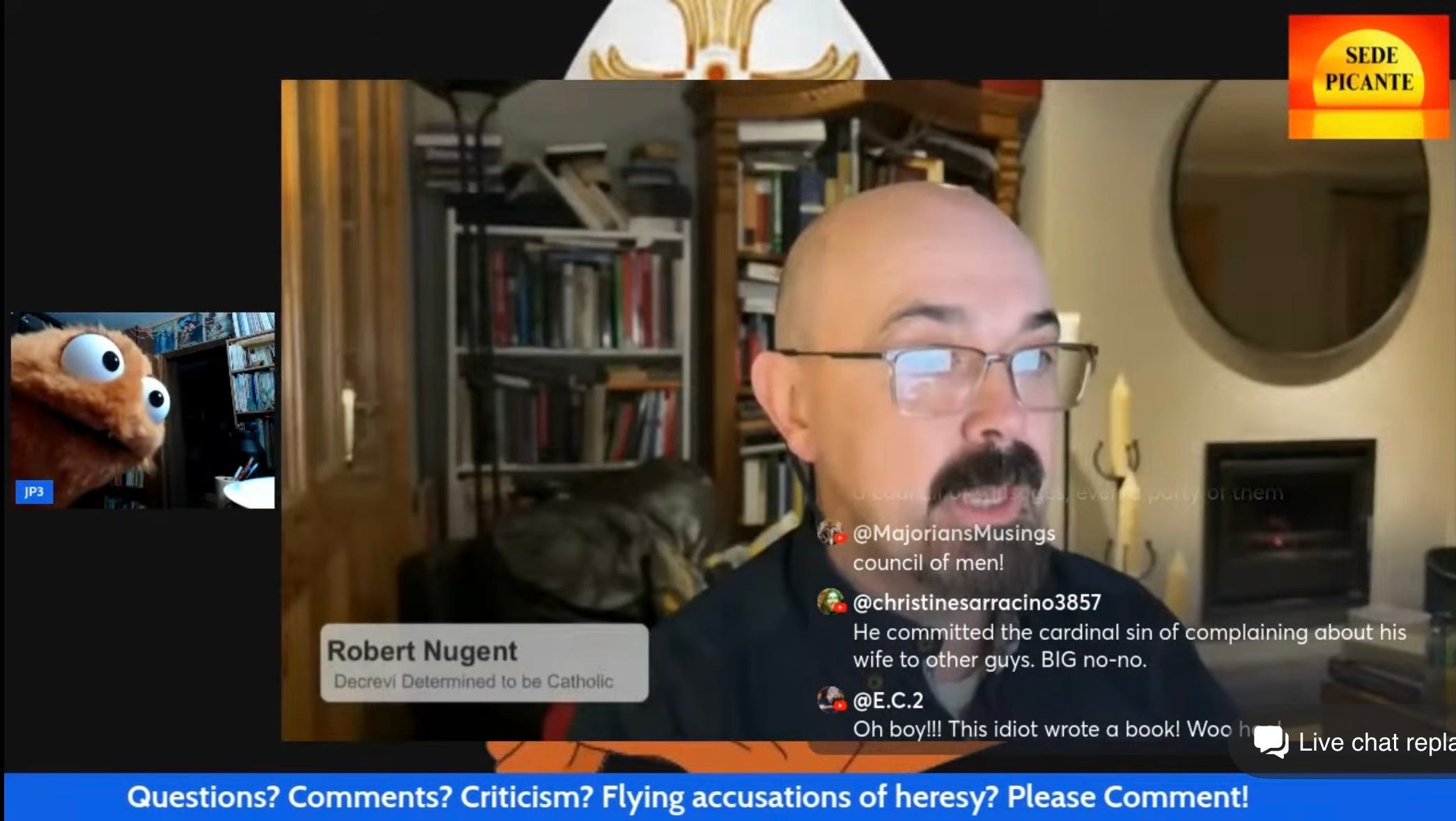
The second is a monologue by Robert Nugent, reacting to a new book on Francis. He offers a string of contradictions dressed up as mystical exhortation. Nugent’s tone is softer than Imbarrato’s. That makes him more dangerous, because he functions as spiritual anesthetic for Catholics trying to stay sane while the ecclesiastical landscape keeps shifting under their feet.
Both videos matter because they are not isolated performances. They are examples of an emerging style of post Francis, post election Catholic media: a new apologetics of compliance. It is not the old ultramontane defense of the papacy grounded in precision, theology, and well defined limits. It is a mood based obedience culture that treats Catholic doctrine as less important than Catholic “attitude,” and treats sacrilege, scandal, and doctrinal rupture as “a trial” meant to deepen your “relationship.”
You can tell what a regime fears by what it spends its time naming, defining, and pathologizing.
These two recordings are training films. They do not exist to clarify doctrine, draw lines, convert souls, or restore reverence. They exist to reframe the postconciliar crisis as a personality disorder among the faithful, then prescribe the same medicine every time: stay quiet, stop noticing, trust the process, and receive your next set of novelties as “a trial” meant to deepen your “relationship.”
And once you see the pattern, you recognize the strategy. Leo’s synodal machine does not need to win arguments. It needs to make arguments feel indecent.
The trick: replace theology with therapy
Fr. Imbarrato begins by redefining the battlefield. The Church is “vibrant” elsewhere, you are “American influenced,” you need an “attitude adjustment,” you are trapped in “chronic church criticism.” The opponent is no longer error. The opponent is your mood.
This is the postconciliar genius: turn the dogmatic question into a psychological diagnosis. Now the faithful man who objects to sacrilege is not defending the Eucharist. He is suffering from “lack of mercy.” The man who refuses to call a false religion “a path” is not guarding the First Commandment. He is being “pharisaical.” The woman who sees a doctrinal contradiction is not recognizing a contradiction. She is “online,” “influenced,” “narrow.”
Once the debate is renamed, the conclusion is guaranteed. Therapy never ends with anathemas. Therapy ends with “be gentler,” “trust,” “stop fixating,” “stop judging,” “stop noticing.”
The revolution is not defended as true, but as necessary for your emotional growth.
“The universal Church” as a gag order
A second move follows immediately. When the crisis appears undeniable in the West, the answer is “Africa.”
Imbarrato’s argument is not really about Africa at all. It is a rhetorical relocation. If you complain about Communion in the hand, sacrilegious receptions, doctrinal fog, liturgical clownery, bishops blessing what God condemns, the response is: that is a local optics problem, you are confusing your neighborhood with “the universal Church.”
This is useful to Leo’s system because it turns concrete scandals into provincial whining. It trains you to treat obvious disorders as parochial neuroses. It also gives cover to the program itself: if growth exists anywhere, the program is vindicated everywhere.
Notice what disappears in this move. The question is not whether the Church has grown. The question is whether the faith has been preserved. A religion can grow by becoming something else. Every heresy can draw crowds. Every counterfeit can scale.
The pre-Vatican II mind understands that numbers prove nothing when doctrine is being domesticated and the sacraments are being treated as social glue.
The Holy Spirit as a shield for novelty
Both speakers deploy a familiar charm. Christ promised the Holy Spirit. Therefore, the current Roman program cannot be fundamentally wrong. Therefore, the faithful must stop “undermining.”
This is one of the most effective modern slogans because it exploits a true premise to justify a false conclusion. The Church is indefectible. The Church cannot teach error as Catholic dogma. The Church cannot become a different religion.
The postconciliar move is to treat chaos as if it were protected doctrine. Then the defender of tradition becomes the dissenter. He is accused of “not trusting the Holy Spirit” because he refuses to applaud an experiment.
In practice, this turns the Holy Spirit into a bodyguard for whatever is currently fashionable in Rome. It is a sacrilege of its own kind: invoking the Third Person of the Trinity to keep Catholics docile while they witness any sort of evil.
Mercy redefined as permission, even at the altar rail
Here the mask slips.
Imbarrato explicitly claims that sacrilegious Communions may be tolerated, even welcomed, as a conversion strategy. He frames the choice as either allow openly practicing LGBTQ persons to receive sacrilegious Communion, or “ostracize” them by refusing and denying them any chance at conversion. He suggests the Holy Spirit will sort it out, and that the priest who objects is trying to define how the Holy Spirit works.
The Catholic Church has never taught that you invite sin into the sanctuary so that grace can later clean it up. The Church teaches the opposite. The Eucharist is not bait. The Eucharist is the Body, Blood, Soul, and Divinity of Christ, and those who receive unworthily eat and drink judgment upon themselves. A shepherd who speaks this way is not being merciful. He is being careless with fire.
This is the synodal posture in miniature. The line is always moved from doctrine to accompaniment. From sin to “irregularity.” From repentance to “process.” From sacrilege to “risk.” The cost is always paid by someone else.
Leo’s regime thrives on exactly this: perpetual openness without conversion, perpetual welcome without judgment, perpetual Communion without confession, perpetual talk of mercy without fear of God.
The Latin Mass as scapegoat, tradition as suspect
The segment about the Latin Mass is a clinic in postconciliar management.
Imbarrato says he does not really have a liturgy problem, he has a heart problem. He says Francis did not have a problem with the Latin Mass “per se.” He suggests the suppression was a response to attitudes, to people using it “as a club,” to complaining.
This is a sophisticated inversion. It portrays the Latin Mass not as a treasure unjustly restricted, but as a psychological trigger for pride and division. Then it recasts the suppression as a kind of spiritual correction.
That lets Leo’s system do two things at once.
First, it keeps the crackdown. Second, it gains the moral high ground by implying that the victims deserved it, not because their rite was wrong, but because their attitude was wrong.
And now every traditional instinct can be categorized as weaponization. Every doctrinal objection can be diagnosed as club use. Every insistence on reverence becomes lack of mercy. Every refusal to accept novelty becomes division.
This is how a regime neutralizes resistance without needing to refute it.
Nugent’s catechism of collapse
Nugent is doing something subtler than Imbarrato, which makes him more useful to Leo’s ecosystem.
Imbarrato is the blunt instrument. Nugent is the soft glove over the fist.
He starts with a fairly normal observation, that Francis steered the bark onto the rocks and faithful Catholics were treated punitively. He even repeats the line about Francis being strangely unconcerned with schism. He admits people went Orthodox, went sede, walked away. All of this sounds like he is about to say the obvious: Rome created a crisis, therefore Rome must repent, correct, and reverse.
Then he swerves. He changes the defendant. The problem becomes the faithful who reacted.
If you left, you never understood the faith.
If you can’t sleep because a pope is challenging you, welcome to the battle.
If you walk away during the Church’s suffering, you never met Christ.
That is not an argument. That is a moral cudgel.
It converts a public ecclesial scandal into a private psychological test. It frames your reaction as the sin, and the cause of your reaction as the cross you must embrace. The mechanism is always the same: replace the content question with a loyalty question. Replace doctrine with endurance. Replace clarity with mysticism.
This is the new catechesis.
“Encounter” as an escape hatch from doctrine
Nugent’s central claim is one of the defining slogans of the postconciliar era: the faith is not a set of teachings in a book, it is encounter, relationship, soul experience.
That sounds pious until you notice what it smuggles in.
If the faith is fundamentally encounter, then the dogmas become secondary. Dogma becomes scenery for your spiritual journey. Moral law becomes a call rather than a command. Contradictions become complexities. Ambiguity becomes humility. The Church’s public teaching office is reduced to a background soundtrack for a personal interior narrative.
This is why the encounter language is so valuable to Leo’s synodal program. It dissolves boundaries without having to argue against boundaries. It makes doctrine feel like an optional accessory to spirituality, a brittle book approach contrasted with the warm glow of relationship.
The pre Vatican II Catholic instinct sees the danger immediately. A relationship with Christ severed from the defined Christ is a relationship with an imagination. Mysticism without dogma is a dream. Spirituality without obedience to revealed truth is sentimentalism dressed as holiness.
Nugent is offering exactly the kind of spirituality that allows Leo’s system to keep changing definitions while telling the faithful they are going deeper.
Scapegoating the conscience as “comfortable Catholicism”
Nugent repeatedly ridicules the desire for comfortable Catholicism, implying that those who want clarity, stability, and doctrinal firmness are seeking ease, not truth. He frames the present crisis as an exciting time, a thrilling trial, almost a spiritual adventure.
That framing is deeply convenient. It makes the refusal to normalize scandal feel like a failure of mystical maturity. When the faithful object to moral and doctrinal chaos, the proper answer is not “stop wanting comfort.” The proper answer is “yes, the Faith has content, and it is being violated.”
The demand for clarity is not comfort seeking. It is fidelity. A father who wants his children protected from poison is not asking for comfort. He is asking for bread.
The comfortable Catholicism trope is a rhetorical trap designed to delegitimize the conscience.
Why Leo’s ecosystem needs both men
Imbarrato operates as an enforcer. Nugent operates as a chaplain.
Imbarrato frightens. Nugent soothes. Together they produce the same output: Catholics trained to interpret ecclesial disorder as a personal spiritual exercise rather than a public scandal that demands correction and reparation.
That is why the second video is the emotional support structure that keeps the first one from backfiring.
Where Sede Picante fits in
Satire cannot substitute for theology. It can, however, puncture the spell.
These men rely on a tone of moral seriousness that makes the listener feel small. They speak as if disagreement is adolescent. They present their categories as self evident. They act as if their framing is the only framing permitted inside the Church.
Mockery, used carefully, exposes how much of that is performance.
That is why The Sede Picante episodes matter for readers who want a quick primer before wading into the long argument. They isolate the rhetorical tricks, replay the most damning lines, and put the contradictions on display without the fog of pious mood music. All of this is accomplished while also being entertaining, intelligent, and very humorous. If you only have time for one, I thought the one reacting to Robert Nugent was the funniest.
Sede Picante reacting to Fr. Imbarrato:
Sede Picante reacting to Robert Nugent
If you value independent Catholic analysis and want to help keep this work going, you can make a contribution or subscribe below. Every donation and subscription directly supports the writing, research, and production of Hiraeth in Exile.
Thank you for helping preserve independent Catholic journalism rooted in truth and tradition.
If I didn't laugh I would cry.
I have argued incessantly with Fr Imbarrato and find him very uninformed with true catholic teaching. He has a fixation on the pope and thinks he is infallible every time he opens his mouth.He doesn't understand the faith and the pope are two different things aND THE POPE MUST PROTECT THE FAITH not make the faith. He has not been catholic long! This is why men should not be priest un less they have been catholic at least 20yrs.