
When Jerusalem Missed the Hour
Christ weeps over the holy city, cleanses the Temple, and warns every Catholic to recognize grace before the hour of visitation passes.

The Catechism Beside the Window
Every Tuesday after school, the girl went to her grandmother’s house and found the same things waiting near the front window: a chipped blue teacup, a black rosary, and an old catechism with cloth boards worn white at the corners.
She was twelve and had already learned to be embarrassed by the book. Her friends spoke about religion as something their grandparents had endured. At her parish, the lessons had become vague enough to offend nobody and memorable enough to last until the parking lot.
Her grandmother opened to the first page.
“Why did God make you?”
The girl recited the answer in the bored sing-song of a child repeating something learned years before.
“To know Him, to love Him, and to serve Him in this world, and to be happy with Him forever in the next.”
“Again,” her grandmother said.
“I said it.”
“You rattled it off. Say it as though it concerns you.”
The girl sighed, looked toward the clock, and began again.
Her grandmother never attempted to entertain her. They covered the commandments, the sacraments, the requirements of a worthy confession, the occasions of sin, the duties of one’s state in life. Some Tuesdays went well. On others, the girl stared through the window and counted the minutes until her mother arrived.
The old woman kept teaching.
Twenty-five years later, the granddaughter sat beside a hospital bed while her own child was being prepared for surgery. The nurses had been kind. Friends had sent messages. She had heard many assurances, most of which dissolved as soon as she tried to remember them.
Then the first question of the catechism returned with the sound of her grandmother’s voice.
Why did God make you?
She opened her purse, found the rosary she had carried for years without often using, and began the first decade.
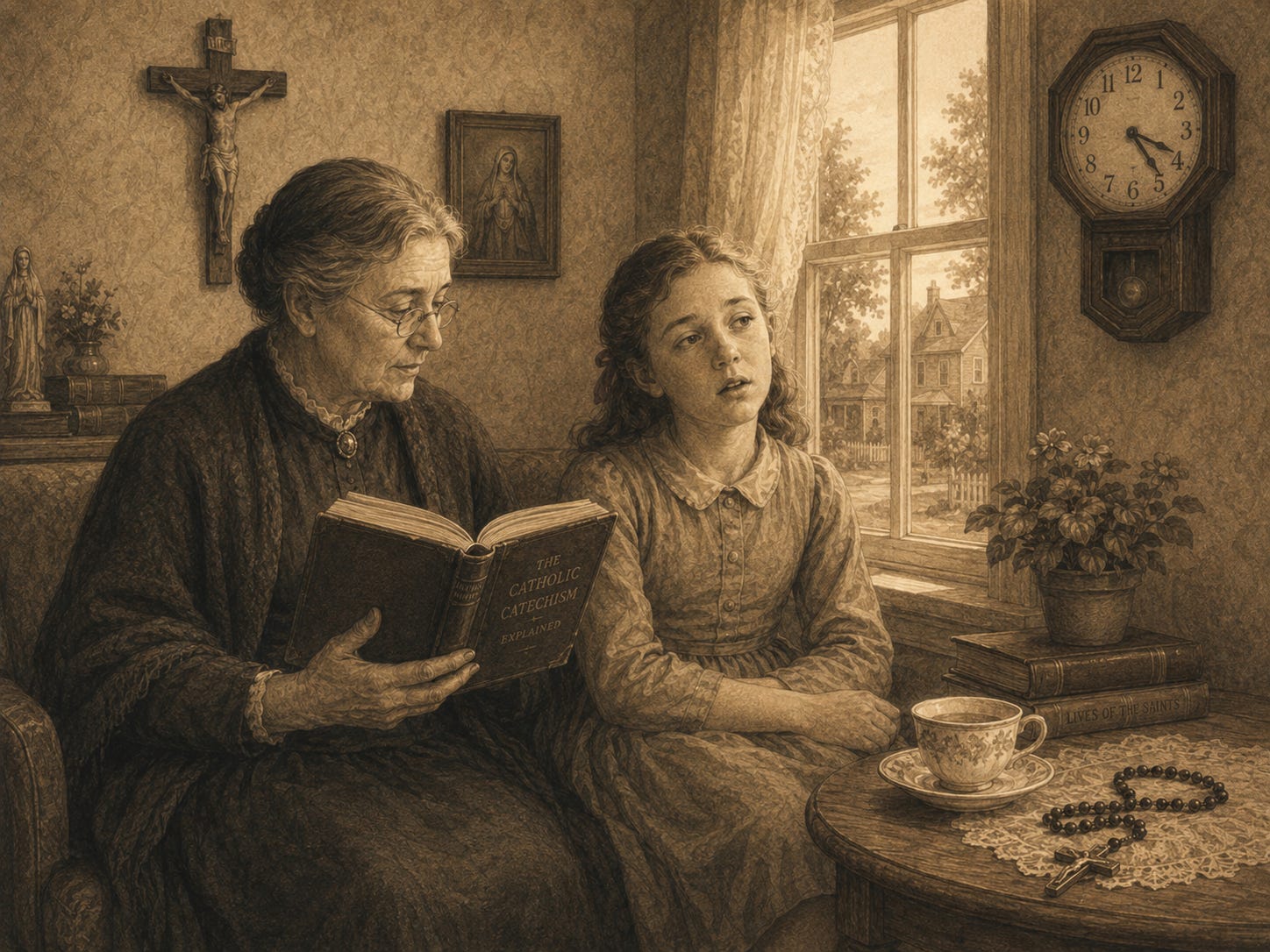
Catholic artists have long pictured St. Anne teaching the young Virgin Mary from a book. Scripture gives us no scene from Our Lady’s childhood lessons, though the image expresses a thoroughly Catholic conviction. Before Nazareth, Calvary, and Pentecost, there was a household in which the things of God were treasured and handed on. St. Anne’s commemoration falls on this Ninth Sunday after Pentecost, and her hidden work provides a quiet counterpoint to the Gospel’s ruined city.
Jerusalem failed in the full light of history. St. Anne served God in rooms the chroniclers never entered. The future of the Faith often turns on work that looks very much like an old woman repeating a question beside a window.
A City in Full Sun
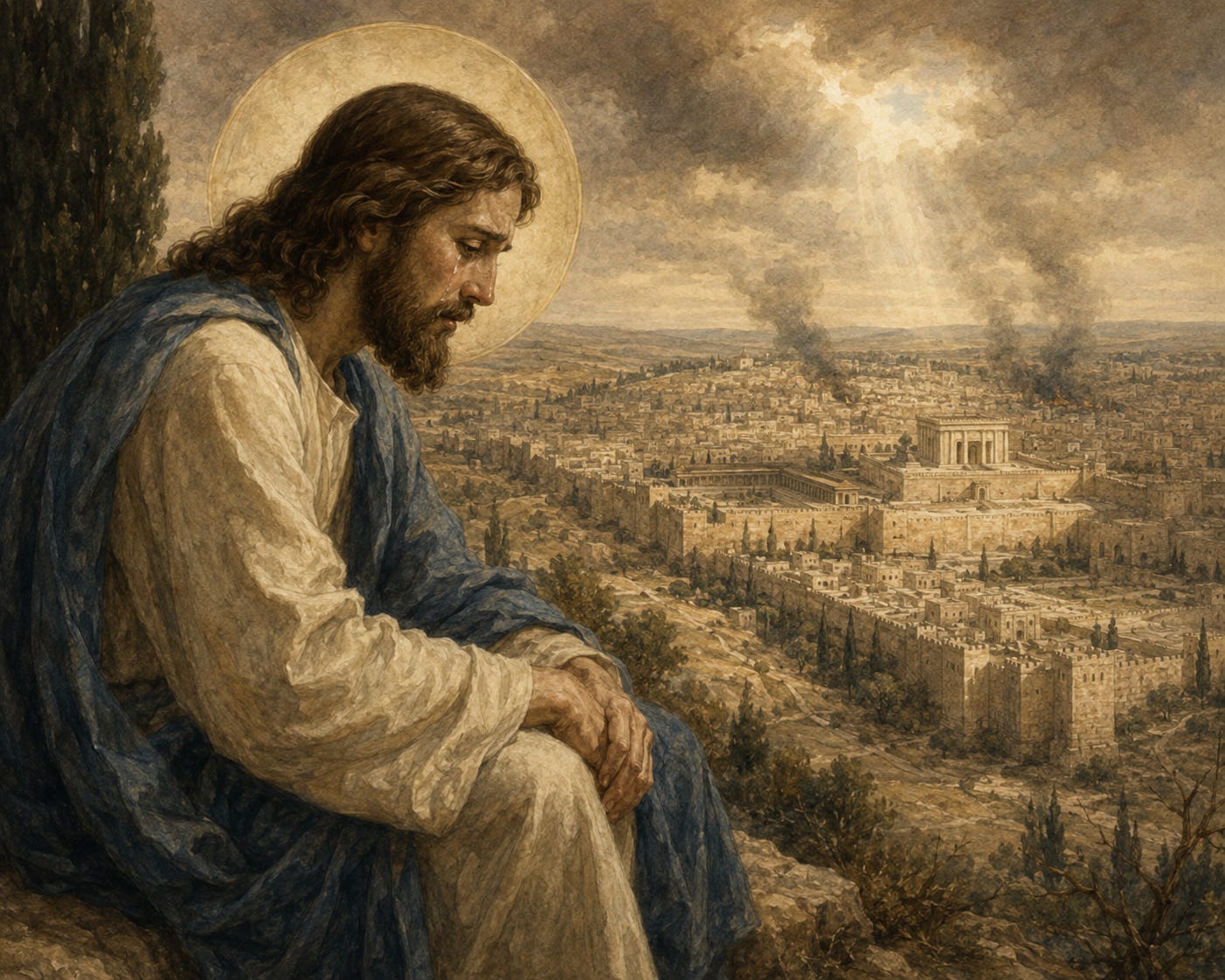
Our Lord approaches Jerusalem from the Mount of Olives.
The city does not look doomed. Its walls stand firm. The Temple dominates the ridge, white stone and gold catching the sun. Pilgrims fill the roads for Passover. Only recently the crowd had cried out to the Son of David.
Christ looks upon it and weeps.
Dom Guéranger describes this Sunday as the Sunday of Jerusalem’s lamentation. The Western liturgy places before the faithful the city that received the Law, the prophets, the Temple, the sacrifices, and finally the Messias Himself. In A.D. 70, Roman troops enclosed it, famine consumed it, and the Temple disappeared beneath fire and demolition. The catastrophe arrived within the generation Our Lord had warned.
“If thou also hadst known, and that in this thy day, the things that are to thy peace.”
Jerusalem had been visited by grace in forms nobody could plausibly miss. Blind men left the roadside seeing. Lepers returned clean to their families. Devils fled. The dead came out of their tombs. The Word made flesh taught in her streets and entered her sanctuary.
Her rulers could cite Scripture. They knew the ceremonies, the feast days, the legal distinctions, and the proper channels. They knew enough religion to recognize that Christ threatened the arrangement by which they governed. Their knowledge had ceased to lead them toward God. It had become equipment for resisting Him.
A religious establishment can remain busy long after it has lost the power to recognize a visitation. Offices keep issuing documents. Experts continue meeting. Ceremonies continue. Money moves. The sacred vocabulary remains available for official use.
The Temple was still functioning when Our Lord announced its destruction.
The Peace Jerusalem Chose
Jerusalem’s leaders wanted peace with Rome, stability for their institutions, and enough religious authority to preserve their standing among the people. Christ brought a peace that began with repentance and divine kingship. That peace demanded too much.
Men frequently call an arrangement peaceful because open conflict has been postponed. A family may look calm because everyone has learned to work around the father’s temper. A parish may avoid controversy because the priest has removed every doctrine likely to disturb a donor. A chancery may speak of communion while investigating the families most serious about passing the Faith to their children.
Rome has spent years praising dialogue while treating the inherited Mass as a disciplinary problem. Ambiguity is granted room to breathe; tradition receives forms, deadlines, permissions, and inspections.
That is the peace of a ruling class protecting its settlement.
The peace of Christ restores right order between God and man. It cleanses the conscience, repairs injustice, governs appetite, and brings the creature beneath the law of the Creator. Once that peace is refused often enough, the soul loses its taste for it. The warning that once caused unease becomes irritating. Then it becomes invisible.
Jerusalem’s blindness had a history. So does ours.
The missed confession, the compromise that worked, the doctrine softened to spare embarrassment, the silence rewarded with promotion—each choice prepares the eyes to miss something larger. By the time judgment appears on the ridge, men may sincerely believe they have been managing prudently.
The Glass at the Wedding
An older man stood at his daughter’s wedding reception with a glass of champagne in his hand.
A waiter had placed it there while the guests gathered for the toast. Nobody around him knew he had stopped drinking twenty-three years earlier. His daughter knew. His wife knew. A priest and several men from an old recovery group knew. To everyone else, he was simply the bride’s father holding what the rest of the room held.
During his first sober years, he had counted days. He had attended meetings after work, made humiliating apologies, and endured evenings that seemed to move a minute at a time. Eventually sobriety became the settled shape of his life. The danger felt remote.
He watched the bubbles climb the side of the glass.
One drink at your daughter’s wedding. Who could object?
The thought arrived without urgency. That calmness frightened him more than a craving would have.
Across the room his daughter was laughing beneath a strand of white lights. He remembered the birthday he had missed, the morning she had found him asleep in the car, and the years when his wife studied his face before deciding how to speak.
He put the champagne on a passing tray and ordered ginger ale.
His daughter found him outside later, near the parish garden.
“I saw you,” she said.
He tried to brush it aside.
She took his arm. “I saw you put it down.”
“I know what picking it up costs.”
They stood there a moment before returning to the reception.

“Let him that thinketh himself to stand take heed lest he fall.”
St. Paul is speaking to Christians who have already received great favors. Israel passed through the sea, ate spiritual food, drank from the rock, and still fell through idolatry, impurity, presumption, and murmuring. Baptism begins the Christian life. It does not remove the need for vigilance.
Past victories carry no guarantee that the appetite has forgotten its old address. The man at the wedding remained sober partly because he remembered the wreckage more honestly than the glass advertised it.
The Exit Usually Appears Early
The Epistle contains one of the most consoling promises in Scripture:
“God is faithful, Who will not suffer you to be tempted above that which you are able; but will make also with temptation issue, that you may be able to bear it.”
The older English word “issue” means an outlet or way of escape.
Most exits from temptation look unimpressive. The phone can be put in another room. The invitation can be declined. The conversation can end. A man can walk outside, wake his wife, telephone the priest, say the Hail Mary aloud, or leave the drink on the tray.
Grace often provides the door before the room feels dangerous.
Goffine warns against the presumption of entering a temptation willingly and expecting God to produce a spectacular rescue later. Divine fidelity assures us of sufficient help. It gives no indulgence to curiosity, vanity, or the decision to linger near a familiar fall.
The ecclesiastical crisis has its own temptations, and they deserve to be named accurately.
A Catholic can grow frightened enough to imagine that the men occupying the offices have somehow acquired control over Christ. He can become tired enough to accept falsehood for the sake of quiet. He can call cowardice prudence and then praise himself for avoiding extremes. He can also permit justified anger to consume everything else God has given him.
The answer is neither silence nor blindness. Publish the evidence. Expose the contradiction. Defend the Mass. Warn families when wolves approach. Then use the exits grace supplies when anger begins claiming authority over prayer, sleep, marriage, and judgment.
The watchman has to remain capable of seeing the city he is guarding. Hatred clouds the eyes as surely as cowardice does.
Tears on the Road, Tables on the Floor
Christ descends into Jerusalem and enters the Temple. The same Heart that wept over the city begins throwing out merchants.
“My house is the house of prayer; but you have made it a den of thieves.”
His tears and His severity belong together. He grieves because He loves. He drives out the traders because the holy place belongs to His Father and the souls entering it deserve something better than a religious market.
Haydock observes that the tears reveal genuine human affection, perfectly ordered in Christ. The Fathers also read the Temple as a figure of the Church and warn against those who use sacred office for private gain or conceal wickedness behind ecclesiastical appearances.
The traffic in the Temple probably came with reasonable explanations. Pilgrims required animals for sacrifice. Foreign coins had to be exchanged. An established system had grown around practical needs. Each interest could point to some legitimate purpose.
That is how corruption usually takes possession of holy places. It rarely walks in carrying a sign marked PROFANATION. It arrives as convenience, adaptation, revenue, efficiency, inclusivity, or pastoral necessity. The boundaries shift a few feet at a time. Before long, the noise of exchange is part of the atmosphere.
Christ did not appoint a listening session with the money changers. He cleared the court.
The Confessional Behind the Folding Chairs
A young priest arrived at a parish where the old wooden confessional served as a storage closet.
When he opened the door, he found folding chairs, cardboard boxes, extension cords, two broken music stands, old banners, and a plastic camel from a Nativity set. The sliding screen was stuck. A stack of parish directories covered the kneeler.
The pastor said the reconciliation room near the office was friendlier. Few people came anyway.
On a Saturday morning, the young priest began carrying things out.
He scrubbed the wood, freed the screen, replaced the curtain, and hung a small crucifix where the penitent could see it. Then he added one hour of confession to the parish schedule.
Nobody came the first week.
During the second week an elderly man entered after forty minutes. He had been away from confession for seventeen years.
By the end of the month, five or six people were coming regularly. During Advent the priest began arriving early because a line had already formed by the announced hour.
One evening he remained in the confessional after the last penitent left. The church was dark except for the sanctuary lamp. A room that had stored junk for years had again become a place where mortal sins were spoken, absolution was given, and men left reconciled to God.
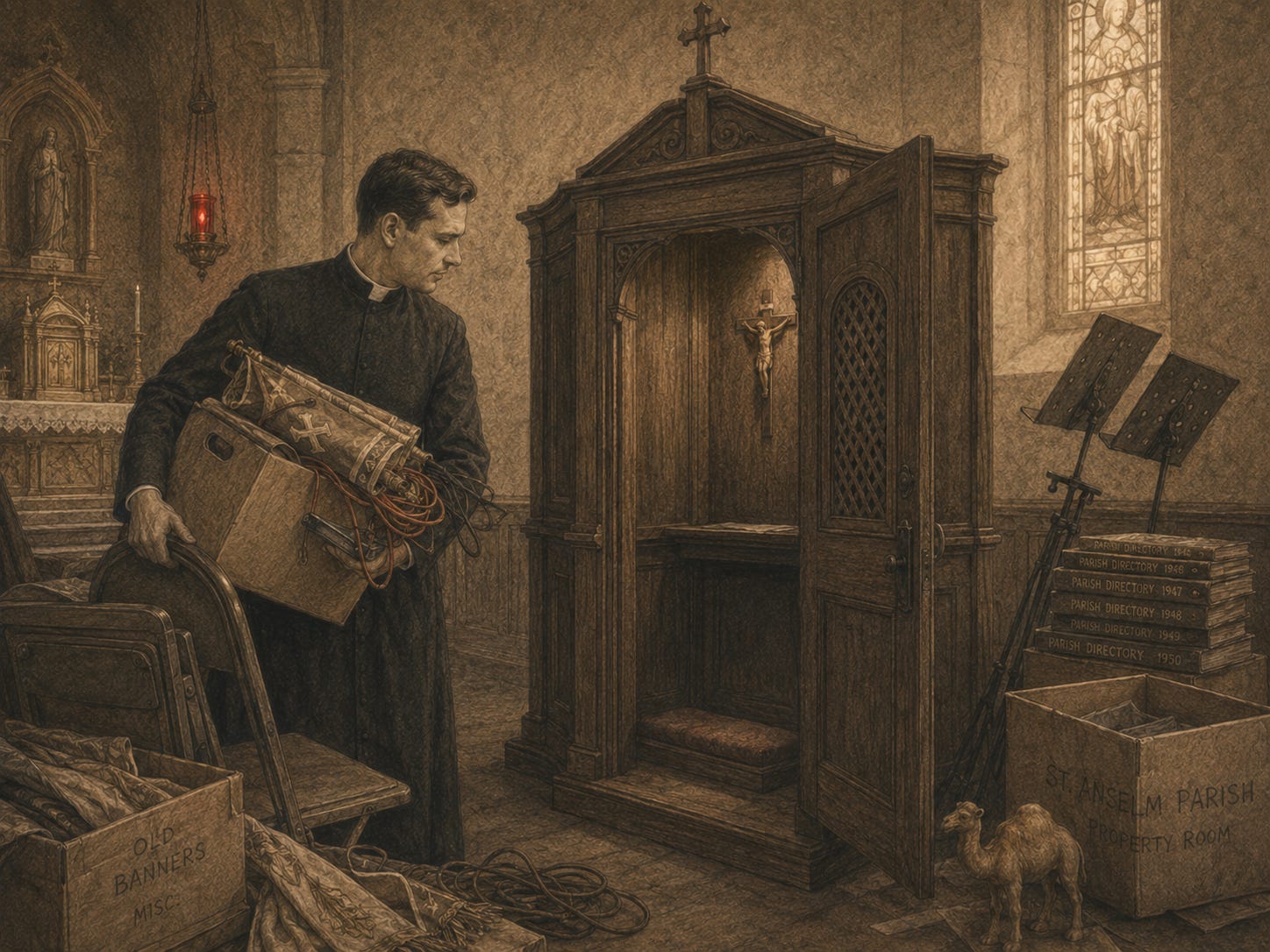
The parish had interpreted an unused confessional as proof that people had lost interest in confession. Perhaps the people had interpreted the buried confessional as evidence that the parish had lost interest in their sins.
Much of Catholic restoration begins with plain work. Carry out the chairs. Repair the screen. State the hours. Preach about mortal sin. Sit there even when the church is empty.
Mercy needs a place where a sinner can find it.
A Den of Thieves with a Communications Office
Christ’s words reach beyond crude financial theft.
An ecclesiastical institution can use the Church for influence, ideological revolution, career advancement, sexual license, social approval, or protection of its own ruling caste. Such an institution may have a finance council, a strategic plan, media professionals, and a vocabulary of welcome. None of that changes the ownership of the house.
The conciliar establishment spent decades dismantling the visible grammar of sacrifice. High altars disappeared. Communion rails came out. Confessionals became closets. The sanctuary was reshaped around the personality of the celebrant. Catholic teaching passed through a series of euphemisms until many ordinary believers could no longer tell which sins still required repentance.
The results can be seen without special access to an archive: parishes consolidated, religious houses emptied, catechetical memory broken, belief in the Real Presence weakened, and generations formed to think of worship chiefly as an expression of the gathered community.
Then the same authorities found cause for alarm in Catholics drawn to silence, kneeling, sacrifice, and inherited worship.
Traditionis custodes declared the postconciliar liturgical books the unique expression of the Roman Rite’s lex orandi and placed the older Mass under a regime of restrictions and episcopal permissions. The principle was extraordinary: the rite used throughout the Latin Church for centuries was now tolerated as an exception requiring containment.
With Fiducia supplicans, the Dicastery for the Doctrine of the Faith opened the possibility of blessings for same-sex couples and couples living in irregular situations, while insisting that these blessings neither approved the relationship nor altered Catholic marriage doctrine. The official distinctions were elaborate. The public images were simple. Clergy stood before couples whose relationships contradicted the moral law and gave a gesture the entire world understood as ecclesiastical approval. The Vatican soon had to publish a clarification explaining what the declaration supposedly did and did not permit.
The precision used against the old Mass vanished when ambiguity served the revolution.
Under Leo XIV, synodality remains central to Roman governance. In his June 2026 consistory address, Leo listed synodality among the major subjects through which the hierarchy would consider the Church’s mission. The implementation process of the Synod on Synodality is scheduled to continue toward an ecclesial assembly in 2028.
Meanwhile, souls continue to die. Children grow up. Marriages fail. Priests lose courage. Each new process generates documents, meetings, interpretations, and further process.
The Temple exists for prayer.
When Rome Recovered Its Precision
The contrast became especially sharp in July 2026.
After years of doctrinal dispute, restrictions on traditional worship, and failed efforts to secure an acceptable arrangement, the Society of Saint Pius X consecrated four bishops at Écône on July 1. The Society invoked a grave state of necessity and the need to preserve episcopal ministry for the good of souls.
Rome answered the following day. The Dicastery for the Doctrine of the Faith called the consecrations an act of a schismatic nature and declared canonical penalties against the bishops involved. Its accompanying note extended the logic of schism toward clergy and lay faithful under stated conditions.
The SSPX published a timeline recording its requests for dialogue, its efforts to obtain an audience, and its stated reasons for proceeding. The Society denied any intention to establish a parallel jurisdiction and presented the consecrations as a response to the continuing emergency in doctrine, liturgy, and priestly formation.
The state of necessity did not begin at Écône on July 1.
It was built over decades in which Catholic worship was demolished or forbidden, seminary formation collapsed, doctrinal dissent went largely unpunished, and the men who clung to the old Faith were treated as the principal threat to unity. Rome tolerated revolution until the revolution became administration. Then it discovered the full vocabulary of law against those who preserved what Rome had discarded.
The legal decree can state the conclusion of the present officeholders. It cannot erase the history that produced the act. Canonical thunder does not repair the altar, restore the catechism, replenish the religious orders, or make contradiction orthodox.
The Gospel’s question remains embarrassing: who filled the Temple with merchandise?
Who turned the Roman Mass into a concession?
Who gave pastoral shelter to every novelty while demanding submission from the men resisting it?
Who taught Catholics to expect ambiguity when doctrine was at stake and perfect clarity when punishment was being announced?
Our Lord looked upon Jerusalem’s offices, experts, courts, and ceremonies. He saw the ruin their occupants could not see, and He wept.
Teach Us What to Ask
The Collect asks for something subtler than the fulfillment of our petitions:
“Grant that they may ask for what pleases You so that You may fulfill their desires.”
The Church asks God to educate desire itself.
Many prayers begin with a mixture of faith, fear, vanity, affection, and worldly imagination. A mother asks for her child’s success. A priest asks for a larger apostolate. A writer asks to prevail against an enemy. A family asks for security. The requests may contain real goods while missing the one thing Providence intends to give.
God sometimes answers by purifying the request.
The Mother’s Prayer
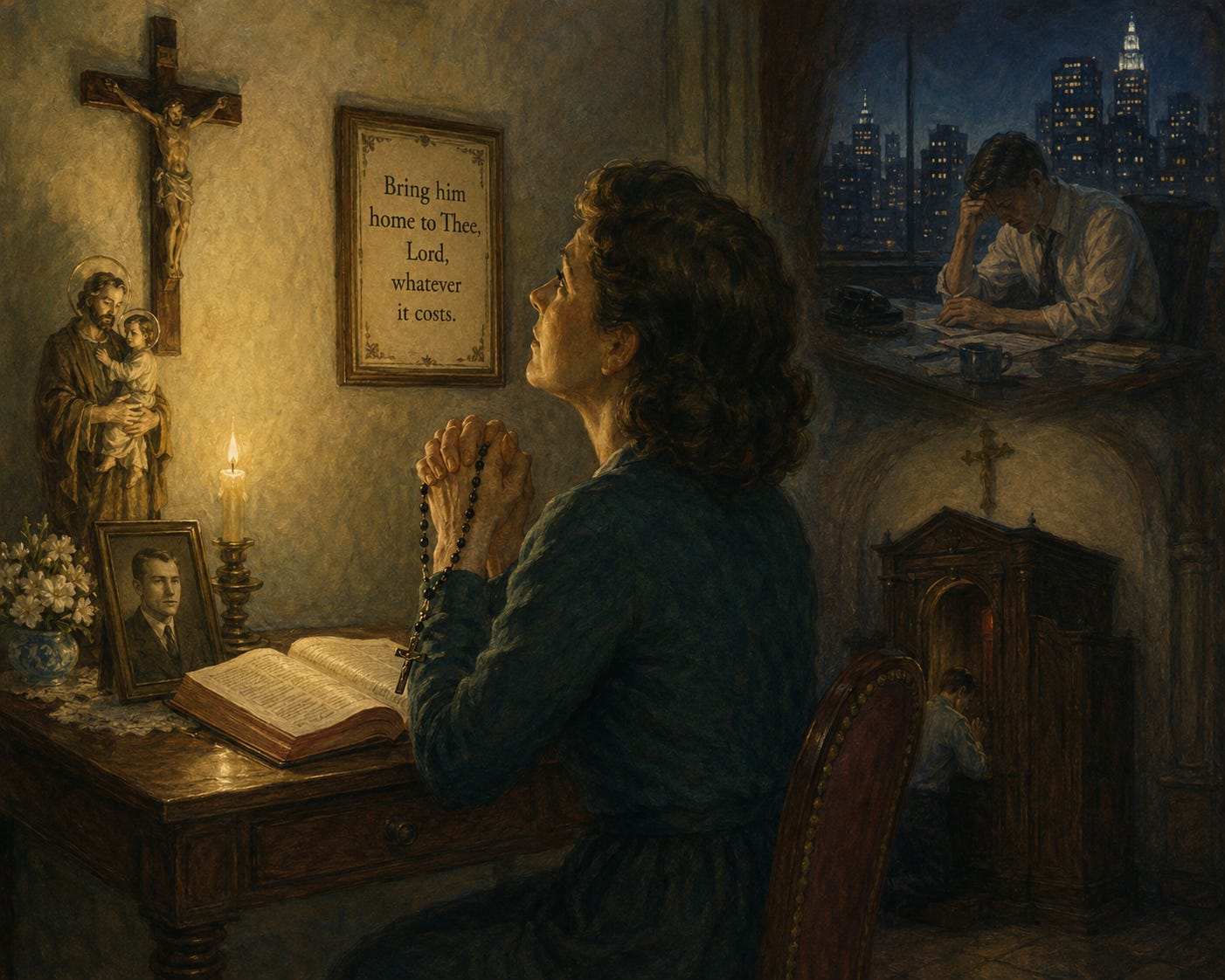
A mother prayed for years that her son would succeed.
He was intelligent, ambitious, and impatient with the limitations of the small town where he had grown up. She wanted him to enjoy the security her own family had lacked. She lit candles before examinations, enrolled him in novenas, and asked St. Joseph to open doors.
The doors opened.
Her son entered a prestigious firm in another city. His salary rose. His calls home became shorter. Sunday Mass disappeared from his life with little announcement. Whenever his mother mentioned the Faith, he changed the subject or assured her that he remained “spiritual.”
One Lent she went to confession and told the priest that God had granted nearly everything she had requested, except the one thing that mattered.
“What are you asking for now?” he said.
“That he comes home.”
“To your house?”
She paused.
“To God.”
“Then ask for that. Use those words.”
Her prayer became: “Bring him home to Thee, Lord, whatever it costs.”
Several months later, the son’s life began to come apart. A promotion went to someone else. The woman he intended to marry left. He telephoned his mother late one night, furious with his employers, his former girlfriend, and eventually himself.
She listened until he had nothing left to say.
“There is a priest five minutes from your apartment,” she told him. “I have kept his number for three years.”
He laughed, though without much humor, and wrote it down.
He did not call the next morning. A week later he did.
The return took time. He made his first confession before Christmas and resumed Mass irregularly at first. His career eventually recovered in a quieter form, with less money and more room for a life outside the office.
His mother had spent years asking Providence to construct a successful worldly life around him. Grace taught her to pray directly for his soul.
God had heard the earlier prayers too. He answered the purified one in a way she would once have feared.
The Sweetness of Commandments
“The precepts of the Lord are right, rejoicing the heart, and His ordinances sweeter than syrup or honey from the comb.”
That sentence sounds foreign to people formed to regard every commandment as an intrusion upon freedom.
A commandment becomes sweet when one sees what it protects.
The law against adultery protects the spouse, the child, the home, the body, and the sworn covenant. The law against false witness protects reputation and justice. The Sunday obligation guards the worship of God against employers, sports schedules, shopping, and our own laziness. The laws governing worthy Communion protect the Blessed Sacrament and the sinner who would otherwise approach judgment carelessly.
Divine law feels oppressive when appetite claims sovereignty. Once the soul returns to order, the commandment begins to taste like release.
This is why doctrinal clarity belongs to mercy. A man lost in fog requires a road, a destination, and a warning before the cliff. A shepherd who offers only welcome leaves the sheep exactly where the wolf found them.
The Work of Redemption
The Secret contains a sentence that exposes how far modern liturgical language has drifted from the Roman instinct:
“As often as this sacrifice of commemoration is offered, the work of our redemption is performed.”
The Mass makes sacramentally present the one Sacrifice of Calvary. Christ remains the principal Priest and the Victim. The ordained priest acts in His person. The altar is therefore neither a stage nor the center of a community meeting. It is the place of sacrifice.
The merchants brought exchange into the Temple. Christ gives Himself.
The old Roman rite keeps this truth before the senses. The priest bows, ascends, kisses the altar, joins his hands, speaks much of the Canon in silence, and carefully purifies the vessels. Signs of the Cross multiply around the oblation. The sanctuary has boundaries. Priest and people face the same liturgical direction.
These practices were never meaningless clutter. They formed Catholics who knew where they were and what was happening.
When sacrificial language fades, Catholic belief eventually follows it. When reverence returns, souls begin recovering the grammar of worship even before they can explain every gesture.
St. Anne and the Domestic Counter-Revolution
St. Anne enters the Mass quietly through the commemorations.
She carried and raised the woman from whom the Son of God received His human flesh. Her work belonged to the hidden years, far from the Temple establishment that would later reject Our Lord.
Grandparents possess a particular power during an age of rupture. They remember things younger Catholics have been told never existed.
They remember churches filled on ordinary Sundays, long confession lines before Easter, Friday abstinence observed without apology, parish missions, family rosaries, Ember Days, Rogation processions, kneeling for Holy Communion, and priests who spoke openly about death, judgment, heaven, and hell.
Memory can become sterile nostalgia. Handed on with love, it becomes a weapon against manufactured amnesia.
A grandmother teaches the prayers omitted from the parish program. She gives an old missal to a grandson and explains why his great-grandfather marked the Canon. She pays for Catholic schooling, drives an hour to Mass, tells the truth about what happened to the parish, and keeps holy cards in a drawer for children who pretend they have outgrown them.
None of this appears in a diocesan plan.
St. Anne’s house issued no pastoral letter. Yet within that domestic school the Mother of God learned the religion of Israel, the Psalms, the promises, the expectation of the Messias, and the habits of prayer that would accompany her to Calvary.
The synodal establishment holds meetings about transmission. Catholic families transmit.
Before the Hour Closes
The Ninth Sunday after Pentecost places three ruins before us.
Israel received miracles and fell through sin.
Jerusalem received the Messias and missed the visitation.
The Temple received sacred worship and became a den.
Each calamity began among people already surrounded by religion. Their danger came from familiarity without conversion, institutions without fidelity, and privilege without holy fear.
Rome must hear the warning. So must every bishop, priest, father, mother, writer, and baptized soul.
The temptation has an exit. Use it before the habit hardens.
The city has an hour. Recognize it while grace remains visible.
The Temple has an Owner. Carry out whatever has entered without His permission.
The Eucharistic Lord still comes among us. Receive Him with faith, repentance, and reverence. Teach the children before the world supplies its own catechism. Ask God to strip our prayers of vanity until we desire what pleases Him.
Christ wept because Jerusalem’s destruction was real, deserved, and avoidable. He had come near with peace. The city’s rulers preferred the order they already controlled.
May St. Anne intercede for the households preserving the Faith while ecclesiastical Jerusalem busies itself with another process. May she guard the grandmothers teaching, the parents sacrificing, the priests rebuilding, and the children who will one day understand why an old book beside a window mattered.
When Our Lord draws near in the hour appointed for each of us, may He find the lamp burning, the children instructed, the confessional open, and the house restored to prayer.
If you value independent Catholic analysis and want to help keep this work going, you can make a contribution or subscribe below. Every donation and subscription directly supports the writing, research, and production of Hiraeth in Exile.
Thank you for helping preserve independent Catholic journalism rooted in truth and tradition.
And the visitation of Our Lord can come in very small ways. A friend of my father's, a member of Alcoholics Anonymous, was depressed and flying home on a business trip which had not gone well. A stewardess was asking passengers if they would like a drink. The friend, whose future sobriety may very well have rested on his decision, was about to say "Yes" to the offer, when he glanced out the window of the plane and saw the logo of the airline on the wing, an American Airlines plane: AA. He politely refused the drink. Actual Grace: enlightens our minds and strengthens our wills to do good and avoid evil.
You are an extraordinary writer...I re-read your articles over and over because they are so profound.
You always hit the nail right on the head. Thanks!!!