
Passiontide Under False Shepherds
When the sanctuary is obscured, the hierarchy disgraces itself, and even Rome kneels where it should rebuke, Christ still judges, remembers, and leads His own to the true mountain.

The Cry of Passiontide
Passiontide begins with a plea that sounds almost indecently direct in an age of managed messaging and ecclesial euphemism.
Do me justice, O God, and fight my fight against a faithless people; from the deceitful and impious man rescue me.
There is no public-relations varnish on that prayer. The Church puts it on our lips because there are seasons when the faithful do in fact find themselves surrounded by treachery, by spiritual fraud, by men who speak in the vocabulary of religion while hollowing out religion from within. The liturgy does not tell us to pretend that such a condition is normal, ask us to flatter corrupt authority, or invite us to baptize betrayal with softer adjectives. It teaches us to appeal over the heads of men to God Himself.
That is why these texts land with such force in our moment.
Traditional Catholics are told, day after day, to calm down, to be strategic, to avoid overreaction, to stop noticing what their own eyes can plainly see. Bishops punish reverence while smiling at irreverence. The old religion is tolerated only under terms of quarantine and supervision. The men who spent years thundering about Francis suddenly discover the virtues of patience, prudence, and nuance once Leo is the problem. The same media class that once knew how to recognize scandal at a glance now develops cataracts whenever the scandal wears a new white cassock.
So the Church gives us Psalm 42.
A plea for judgment.
Because sometimes the faithful are not confused. Sometimes they are being lied to.
“Send Forth Thy Light and Thy Truth”
The Introit does not stop with complaint. It rises into a second petition.
Send forth Your light and Your fidelity; they shall lead me on and bring me to Your holy mountain, to Your dwelling-place.
That line tells us where deliverance comes from. Not from the cleverness of commentators, access journalism, or the next carefully stage-managed reassurance that everything remains institutionally intact. God’s light and God’s truth must lead us. If the age is dark, then the faithful survive by clinging more tightly to what does not change.
This is one reason the old Mass matters so much in a time like ours. It is not merely beautiful. It is morally clarifying. It trains the soul to expect worship to be ordered upward, language to be exact, sacrifice to be central, and God to be God. Once a man has learned that, the postconciliar fog becomes harder to endure and impossible to mistake for health.
The Church today is full of men who want to govern without doctrine, soothe without correcting, and preserve a shell of Catholic symbolism while draining it of its exclusive claims. That is why Passiontide is such a gift. It reminds us that the only way through ecclesiastical confusion is through divine light, not institutional spin.
And that light often humiliates men.
It shows what they were hoping to hide.
This week it was reported that then-Fr. Robert Prevost, now Leo XIV, appeared among the kneeling and prostrating participants in a 1995 ceremony described as a “Celebration of the Rite of Pachamama.”
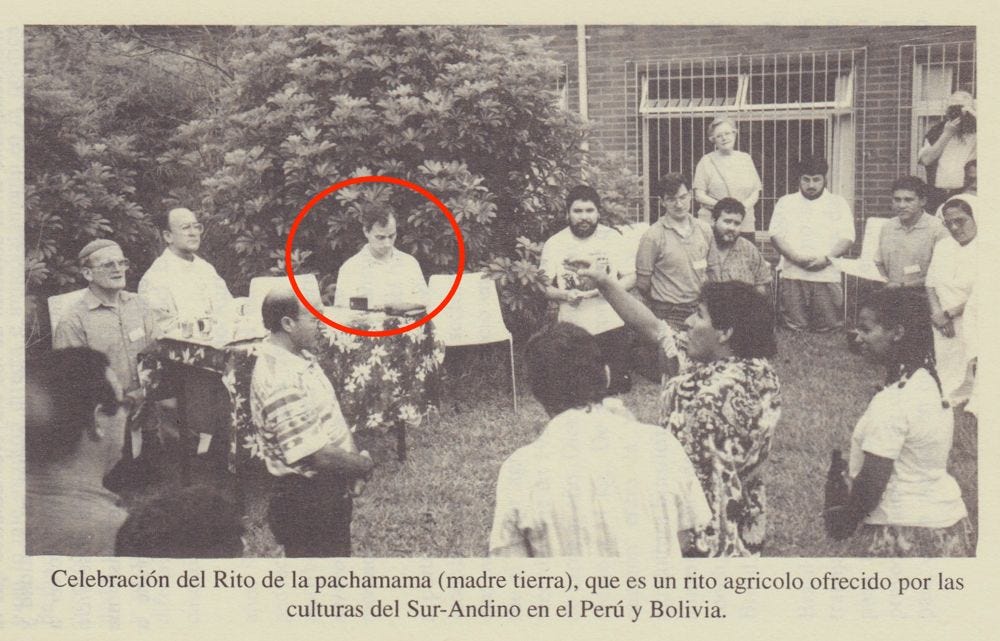
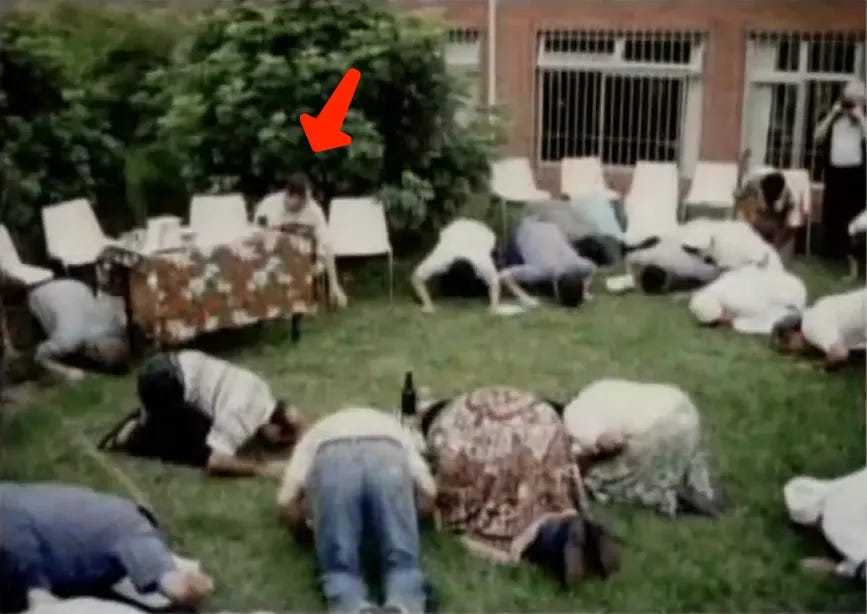
There it is. The modern crisis in miniature.
The man now presented to Catholics as a guardian of unity was, in full adulthood, present on his knees and prostrating in a rite explicitly labeled by the event’s own proceedings as Pachamama. That fact already says enough. The rot was not born yesterday. It was formed in the laboratories of inculturation, liberationism, ecotheology, and the long postconciliar experiment in diluting Catholic worship with the symbols and spirits of the world.
No wonder the crisis feels so deep. Men like this were not accidents. They were produced.
The Blood That Actually Saves
The Epistle from Hebrews cuts straight through the whole counterfeit religion.
Christ entered the holy place once for all not by the blood of beasts but by His own Blood, having obtained eternal redemption. He is the true High Priest. He does not mediate vague cosmic harmony. He does not gather tribes around the earth for a ritual of shared symbolism. He offers Himself to the Father as the spotless victim and cleanses consciences from dead works.
Dead works. That phrase should sting.
Because the modern Church has become crowded with dead works. Endless assemblies, listening sessions, symbolic gestures, choreographed inclusion, ecological pieties, horizontal ceremonies dressed up as renewal. They produce noise, headlines, and administration. They do not cleanse the conscience. They do not convert the nations. They do not drive out idols. They do not save.
The Blood of Christ does.
That is why faithful Catholics must resist the temptation to measure reality by visible triumph. The revolutionaries have offices, microphones, budgets, conferences, dicasteries, and applause. But they cannot manufacture one drop of redeeming blood. They cannot replace Calvary with accompaniment, improve upon the Sacrifice, or outgrow the Cross.
Hebrews recalls us to what is permanent when everything visible feels compromised. The Church lives because Christ offered Himself. The faith survives because the Mediator is faithful, not because prelates are. Our hope rests in a priesthood that cannot fail, even while the men pretending to govern in Christ’s name disgrace their office.
“Much Have They Oppressed Me From My Youth”
The Tract might be the line that best captures the feeling of many serious Catholics right now.
Much have they oppressed me from my youth. Yet they have not prevailed against me.
That is the history of the remnant. It was true in Israel. It is true in the Church. The faithful are oppressed by pagans from outside, then by hirelings from within, then by respectable men who insist that peace requires silence. The furrows run deep. The back is scarred. The plowers are real.
But they have not prevailed.
That last line is the hinge. It is what keeps sorrow from curdling into despair.
They have not prevailed, though they seized churches.
They have not prevailed, though they rewrote rites.
They have not prevailed, though they mocked the old faith as rigidity.
They have not prevailed, though they called idolatrous gestures dialogue and sacrilege accompaniment.
They have not prevailed, though they taught generations to clap where they should tremble.
Why not?
Because the Church is not theirs to reinvent. The Mass is not theirs to deconstruct. The priesthood is not theirs to feminize, psychologize, and subordinate to every passing ideology. Christ has already judged the end of this story. Passiontide is not the victory parade of the wicked. It is the slow unveiling of how God defeats them.
The Tract says the plowers made long furrows. Anyone who has watched the last sixty years knows how deep those furrows go. But then comes the line that steadies the soul:
The just Lord has severed the cords of the wicked.
Not may sever. Has severed.
In principle, in promise, in the inner law of divine providence, their project is already doomed. They may occupy. They may harass. They may humiliate. They may force the faithful into chapels, school gyms, borrowed spaces, side altars, and catacombs. Still, their cords are cut. They do not own the future. They only make noise on the road to their own judgment.
Christ in the Temple, Christ in the Eclipse
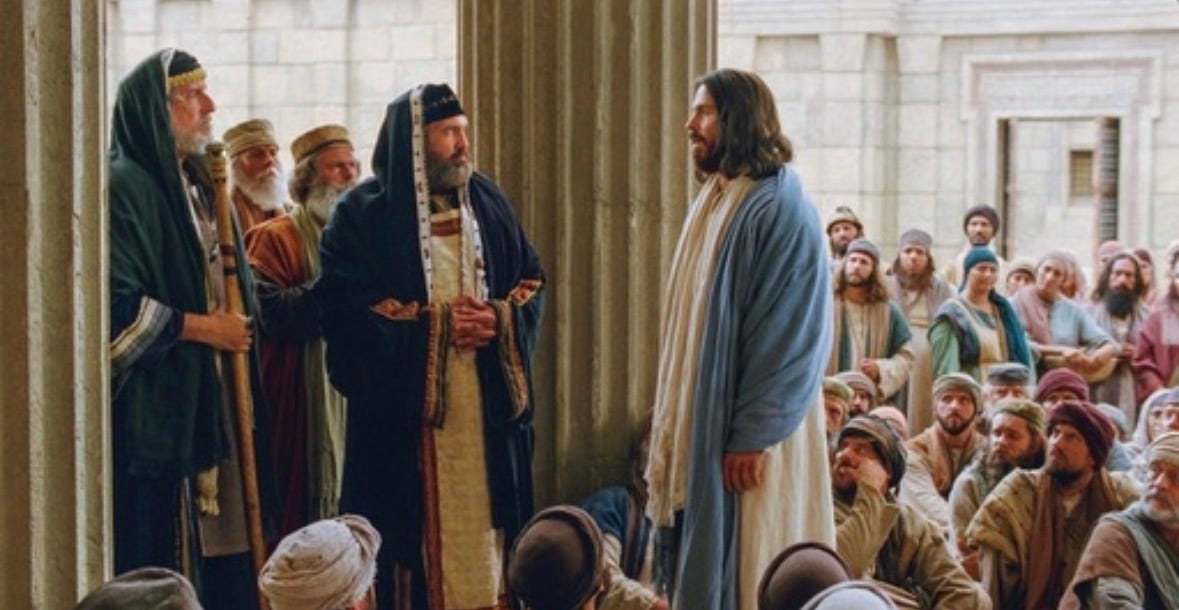
The Gospel is one of the great collision scenes in all of Scripture. Our Lord stands in the temple and simply speaks the truth. That alone is enough to provoke fury. He tells His hearers that they do not know God. He tells them that if He denied what He knows, He would be like them, a liar. Then He speaks the line that shatters everything:
Before Abraham came to be, I am.
This is the point where mediation ends. The problem is no longer misunderstanding. It is hatred of the truth spoken plainly. They take up stones.
That, too, is our age.
What enrages the enemies of tradition is not merely a preference for Latin or lace. It is the survival of an entire theological world they cannot control. The old faith still says God is to be adored, not reimagined. It still says worship has a fixed object and a fixed direction. It still says revelation judges cultures, rather than borrowing gods from them. It still says words matter, doctrine matters, sacrifice matters, priesthood matters, and eternal damnation is not a metaphor.
Men can tolerate ritual nostalgia. They cannot tolerate divine claims.
And so Christ hides Himself and goes out from the temple.
That line is terrible and consoling at once. Terrible, because it describes judgment. Consoling, because it explains our grief. When the temple becomes hostile to truth, when official religion dishonors the Son while speaking piously of the Father, there comes a kind of eclipse. Christ is still God. Christ is still King. Christ is still present to His own. But there is a withdrawal of manifest glory. The sanctuary remains standing while the Presence is treated as an inconvenience.
That is how many Catholics experience the postconciliar wasteland. The structures remain. The titles remain. The ceremonies continue. Yet something has fled from the public face of the institution. Not because Christ failed, but because men drove Him out by refusing His word.
Passiontide understands that sensation better than our commentators do.
Governed in Body, Safeguarded in Mind
The Collect is brief, and for that reason more piercing.
We ask that by God’s grace we may be governed in body and by His protection safeguarded in mind.
Safeguarded in mind. There is the battle.
This crisis is not only about liturgy, appointments, and public scandals. It is about mental colonization. The faithful are pressured to normalize what their fathers would have called intolerable. They are told that scandal is complexity, contradiction is development, and pagan gestures are pastoral outreach. After enough repetition, the soul gets tired. The mind begins to sag. One starts to wonder whether clear judgment itself is some kind of vice.
So the Church prays for protection of mind.
Hold fast to that. In a dishonest age, sanity is a grace.
To look at a man kneeling in a rite labeled Pachamama and say that this reveals something rotten in the postconciliar formation of clergy is not hatred, but sanity. To observe that bishops who persecute the old Mass while tolerating every novelty are not faithful guardians but agents of disfigurement is moral perception. To notice that the professional conservative class has become selective in its courage is not rashness. It is the truth.
Ask God to protect your mind from acclimating to absurdity.
The Bonds of Wickedness
The Secret asks that the offerings may loose the bonds of our wickedness. That prayer applies personally, of course. Every Catholic must bring his own sins to the altar. But it also names the hour. We are living amid networks of compromise, habits of cowardice, loyalties of convenience, and bonds of wickedness that hold together the postconciliar regime.
Some are bound by ambition.
Some by fear.
Some by salaries.
Some by access.
Some by the old temptation to remain inside the room where decisions are made, even if the price is silence while the sanctuary is vandalized.
God can break those bonds too. He has done it before. He may yet do it in startling ways. Men who today whisper may speak tomorrow. Men who today defend the indefensible may find their excuses rotting in their mouths. Men who today are intoxicated by office may become monuments of disgrace in Church history.
Do not imagine that God is passive because He is patient.
“Stand By Us, O Lord”
The Postcommunion is where this Sunday finally settles the heart.
Stand by us, O Lord our God, and protect by Your everlasting help those to whom You have given new strength through Your sacrament.
That is the whole Christian life in a dark age. Not optimism, or naïveté, or denial. Assistance.
Stand by us.
The faithful in every age have had to pray this under bad rulers, corrupt clergy, cowardly scholars, and treacherous elites. Ours are not the first wounds in the Church. They are simply ours. And because they are ours, they feel fresh and unbearable. But the sacramental life is given precisely for this: to keep souls alive when the public face of religion becomes humiliating.
So take courage this Passiontide.
Christ has not yielded His priesthood to ecotheologians.
His Blood has not lost its power because bishops lost their nerve.
His word has not become false because liars occupy offices.
His Church has not died because impostors decorate the ruins.
The enemies of God may plow long furrows. They may kneel before idols in Brazil, rise through the system, and be hailed as guardians of communion. They may spend decades rewarding compromise and punishing fidelity. Even so, they do not get the last word.
Before Augustine, before Brazil, before the council, before the latest round of episcopal mediocrity, before every cowardly article telling the faithful to lower their expectations, there was Christ saying what He still says now:
Before Abraham came to be, I am.
That is why Passiontide still gives hope.
Because the Church is passing through humiliation under men who change, maneuver, flatter, conceal, and fall. But the One who speaks in the Gospel does not change, does not maneuver, does not flatter, does not conceal, and does not fall.
He is hidden for a time.
He is never absent.
And when He judges, every false shepherd will finally discover whose temple this always was.
If you value independent Catholic analysis and want to help keep this work going, you can make a contribution or subscribe below. Every donation and subscription directly supports the writing, research, and production of Hiraeth in Exile.
Thank you for helping preserve independent Catholic journalism rooted in truth and tradition.
Truth Beautifully Written. Thank You
Remarkably hopeful and encouraging. It’s what all of us need to hear loudly and clearly. Thank you.