
“Only Say the Word”
Faith Under Occupation, Healing Under Ruins, Courage When the Commentators Go Quiet

The Kingdom Still Reigns Even When the Courts Are Corrupt
“The Lord is King; let the earth rejoice; let the many isles be glad.”
The Introit begins where every Catholic recovery begins: not with the headlines, not with the latest episcopal press release, not with the latest “prudential” retreat from truth, not with Leo’s newest appointment, not with the nervous hush of the professional Catholics who built careers warning about Francis and now speak in murmurs as the same revolution keeps marching.
The Lord is King.
That line is an anchor. When the visible machinery of the Church looks captured, when the public face of authority feels like a permanent fog machine, the liturgy drags our chin upward and forces our eyes onto the throne.
Sion hears and is glad. Juda rejoices. Why, when the world gives so many reasons to grimace? Because the King’s reign does not depend on the applause of courtiers, nor on the loyalty of hired commentators, nor on whether the men in charge decide to act like fathers or like HR managers. He reigns through storms and through mutinies, through faithful bishops and through cowardly bishops, through saints and through scandal.
This is the first kind of hope the Mass gives today: the hope of reality. Christ reigns even when the earthly offices look compromised. Heaven does not change its constitution because Rome has become theatrical.
“Adore God, all you His angels.”
Notice the order. We adore first. We explain later. We worship first. We strategize later. In times of chaos, everyone wants to become a pundit. The liturgy makes us become Catholics again.
“Look With Favor Upon Our Weakness”
The Collect is brief, blunt, and perfectly timed.
“Almighty and everlasting God, look with favor upon our weakness, and stretch forth the right hand of Your majesty to help and defend us.”
No romantic language, denial, or fake confidence. Weakness is admitted openly. The prayer does not pretend that the faithful are strong, well led, well fed, well protected. It simply asks God to do what men refuse to do: defend.
That “right hand” returns in the Offertory: “The right hand of the Lord has struck with power… I shall not die, but live.” The liturgy is teaching you how to interpret the crisis. The Church is not a self-sustaining brand. The Church survives because God defends her, even when a significant portion of her visible leadership behaves like a bureaucratic class managing decline.
If you feel tired, outnumbered, and constantly told to calm down, to stop noticing, to stop speaking, to stop “being divisive,” the Collect hands you a sentence you can pray without pretending.
Lord, look with favor upon our weakness.
Not our strength. Not our cleverness. Not our access. Our weakness.
That is a mercy, because weakness is what most Catholics possess right now: weak communities, weak preaching, weak formation, weak courage from people who are paid to have courage.
God listens anyway.
St. Paul’s Command for a Time of Provocation
Romans 12 today sounds like a dangerous reading for Catholics who are watching betrayal.
“Be not wise in your own conceits… To no man render evil for evil… If it be possible, as far as in you lies, be at peace with all men… Do not avenge yourselves… Be not overcome by evil, but overcome evil with good.”
A shallow reading turns this into passivity. A cowardly reading turns it into an excuse. A careerist reading turns it into a muzzle.
St. Paul is not writing instructions for cowards to hide behind. He is giving a battle plan for Christians living under pressure, where anger can become a drug and retaliation can become a hobby.
There is a crucial line that people glide past: “Provide good things not only in the sight of God, but also in the sight of all men.”
In plain terms, Christians are supposed to be publicly recognizable as upright. Not gullible. Not silent. Not spineless. Upright.
He also says, “If it be possible, as far as in you lies, be at peace with all men.” The phrase carries limits. Peace has conditions. Peace is not purchased with lies. Peace does not require you to call poison “medicine” because the officials demand the label.
St. Paul forbids revenge. He does not forbid clarity. He forbids being conquered internally by evil. He does not require you to stop naming evil.
The Church’s current crisis tempts Catholics toward two distortions.
One distortion is rage as identity, the endless dopamine loop of outrage, where every betrayal becomes a reason to become less Christian.
The other distortion is the soft religion of “unity,” where truth is treated like a nuisance, and the faithful are told that the real sin is noticing the rupture.
St. Paul cuts both illusions. He calls you to a kind of strength that refuses the devil’s terms. You will not return evil for evil. You will also not call evil “good” so that you can keep your seat at the table.
“Vengeance is Mine: I will repay, says the Lord.”
That line is not a sedative, but a promise of judgment. It is the removal of one temptation so that you can fight cleanly.
When people in high places slander the old Mass, punish reverence, reward novelty, platform confusion, promote the same postconciliar instincts under a different personality, God sees. When major traditional outlets suddenly discover “prudence” because the new regime feels polite, God sees.
Your task is not to become God’s vengeance. Your task is to become God’s witness.
The Leper and the Touch
The Gospel begins with a leper who kneels and says exactly what the modern Church struggles to say:
“Lord, if You will, You can make me clean.”
That is faith with realism. He does not tell Jesus what Jesus must do. He does not bargain. He does not demand. He confesses power. He asks for mercy.
Then comes the moment that should haunt every Catholic living through this era.
“And stretching forth His hand Jesus touched him.”
Christ touches what the world labels untouchable. Christ touches what polite society fears. Christ touches impurity to make it pure.
This matters because much of the postconciliar project has reversed the instinct. It touches the world’s impurities and then asks the Church to adjust her categories so nobody feels judged. The language becomes therapeutic. Sin becomes “woundedness.” Conversion becomes “accompaniment.” The borders that protect the sacred are treated like cruelty.
Christ touches the leper to cleanse him. Not to affirm him or to celebrate his “journey.” Not to explain how leprosy can be integrated into a broader spiritual ecology.
He cleanses him.
The crisis in the Church is not merely administrative. It is the slow replacement of cleansing with coping. The faithful are taught to manage sin rather than flee it, to negotiate with modernity rather than conquer it, to reinterpret dogma rather than submit to it.
Christ’s touch does not negotiate. It heals.
“I will; be made clean.”
That sentence remains true. Not because the Vatican says it. Because Christ says it.
“Show Yourself to the Priest”
After the cleansing, Jesus commands the leper to go to the priest and offer the gift Moses commanded, “for a witness to them.”
There is a structure here. Healing returns you to order. Cleansing restores communion. Religion is not a free-floating spirituality. It has priests. It has sacrifice. It has public worship. It has objective acts that witness to reality.
This is part of what the old liturgy teaches week after week, and what the new order often obscures. Catholicism is not vibes and inclusion. It is supernatural order anchored in sacrifice, priesthood, confession of truth, submission of intellect, discipline of life.
In a time when the visible hierarchy is confused, this line can sting. People ask, “Show myself to which priest?” They have watched priests become activists, therapists, entertainers, functionaries. They have watched bishops police kneeling and ignore blasphemy. They have watched Rome praise movements and personalities that flatten the Faith into slogans.
Christ’s command still stands because the sacramental order still stands, even in a time of sabotage. God has not abolished His own instruments because men misuse them. The abuse of office is not the death of the office.
Hope is not naïveté. Hope is insisting that God’s architecture remains, even when contractors are vandalizing the building.
The Centurion and the Faith That Shames Israel
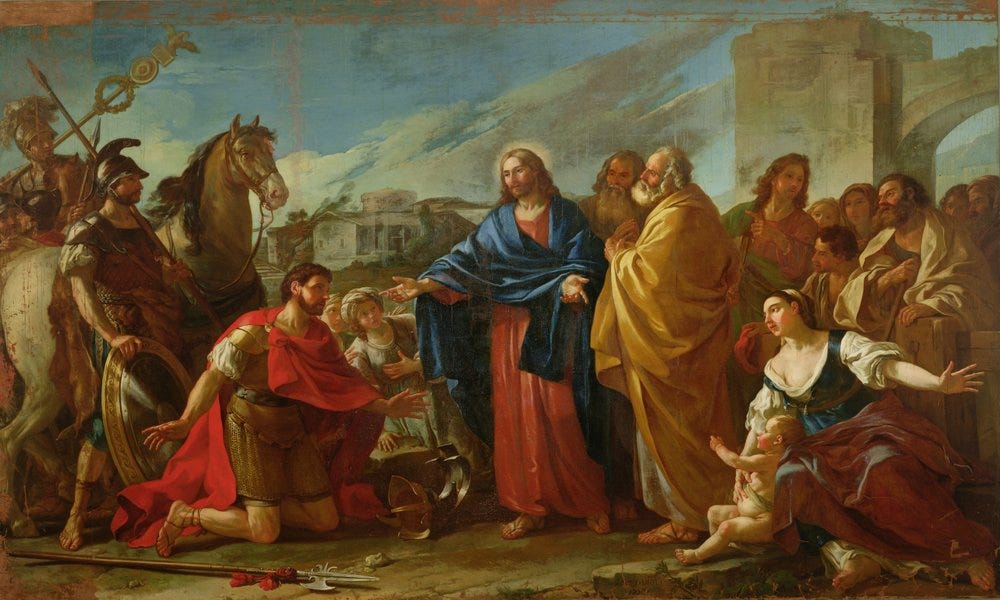
Then comes the centurion.
“Lord, I am not worthy that You should come under my roof; but only say the word, and my servant will be healed.”
He understands authority, command, and obedience. He does not sentimentalize it.
“For I too am a man subject to authority… I say to one, ‘Go,’ and he goes.”
He grasps something that our age hates: authority is real. It is not a collaborative, or a listening session, or a a negotiated consensus.
Jesus marvels. He praises the centurion’s faith. He says He has not found such faith in Israel.
Then He delivers the warning that belongs to every age of complacent religious privilege.
“Many will come from the east and from the west… but the children of the kingdom will be put forth into the darkness outside.”
A person can possess the outward label and lose the inward reality. A person can inherit structures and squander truth. A person can sit near sacred things and become numb.
This is a warning to the institutional class. It is also a warning to trad Catholics who confuse proximity with fidelity. You can know all the scandals, all the names, all the factions, all the gossip, all the drama, all the “inside baseball,” and still lose faith.
The centurion does not have an inside track. He has faith in the word of Christ.
The Church’s current crisis is a kind of occupation. The buildings remain. The titles remain. The ceremonies remain in many places. The confidence that authority is supposed to transmit is often missing. The centurion teaches a way through occupation.
Do not anchor your faith in the mood of the palace. Anchor it in the command of the King.
Only say the word.
A Hope Stronger Than Trad Media Cowardice
Many Catholics are exhausted with the professional commentariat. They watched the industry flourish during Francis. They watched the outrage become monetized. They watched the brave talk become a brand.
Then Leo arrives, speaks in smoother tones, keeps the same postconciliar instincts alive through appointments and priorities, and suddenly the loudest voices discover serenity. Unity. Patience. Trust. Give it time.
Some of that is human weakness. Some of it is fear. Some of it is access. Some of it is the quiet knowledge that the revolution punishes dissent.
The Mass does not base hope on any of these people.
The Mass gives you older sources of courage.
The Lord is King.
Christ touches lepers.
Christ commands priests to witness to sacrifice.
Christ praises a soldier who understands authority.
Christ warns that insiders can be cast out.
Christ heals by His word.
This is why the Church survives. Not because the commentators are bold. Not because the officials are wise. Not because Rome is pure. The Church survives because Christ is true.
There is a form of hope that feels like adrenaline. There is another form of hope that feels like granite.
Today’s Mass offers granite.
You may be outnumbered in your parish. You may be alone in your family. You may feel like every institutional channel has been colonized. You may feel like the men who should defend the faithful are busy managing optics.
Pray the centurion’s sentence anyway.
Lord, I am not worthy… only say the word.
That is not retreat. That is the beginning of recovery.
“I Shall Not Die, But Live”
The Offertory speaks like a man who has seen death and refuses it.
“I shall not die, but live, and declare the works of the Lord.”
This is a defiance rooted in God.
You can say it in the middle of a collapsing diocesan culture. You can say it with children to raise. You can say it in a place where the old Mass is marginalized. You can say it when friends tell you that you are “too intense,” “too negative,” “too rigid,” “too online,” “too divisive,” “too political,” “too much.”
I shall not die.
Not because I am strong. Because God’s right hand strikes with power.
Declare the works of the Lord. Not the works of Leo’s bureaucracy. Not the works of the latest Vatican marketing project. Not the works of the nervous traditionalists trying to preserve their invitations.
Declare the works of the Lord.
“All Marvelled at the Words”
The Communion antiphon is short and quietly devastating:
“All marvelled at the words that came from the mouth of God.”
The people marveled at Christ’s words because His words carried reality. They did not soothe. They created. They judged. They healed.
We live in an era of endless words that carry very little reality. Statements, documents, dialogues, synodal summaries, pastoral frameworks, empty phrases about listening, accompaniment, inclusion, encounter. Verbal confetti.
The liturgy calls you back to words that have weight.
Christ’s word cleanses leprosy.
Christ’s word heals the servant.
Christ’s word warns of darkness.
Christ’s word builds His Church even in the teeth of betrayal.
So take Communion with a straight spine. Do not receive as a consumer of religious goods. Receive as a man living through a civil war who knows the King still reigns.
Marvel at the words from the mouth of God.
Then live accordingly.
A Closing Prayer for the Faithful Who Refuse to Surrender
O Lord, look with favor upon our weakness. Stretch forth Your right hand to help and defend us. Cleanse what is diseased in us, in our homes, in our parishes. Give us the centurion’s faith, calm and untheatrical, obedient to Your word, unmoved by the gossip of the palace.
Give us charity without softness, clarity without cruelty, peace without lies.
Make us worthy of the fruits of this sacrament, so that we do not merely survive this crisis, we become saints in it.
Only say the word, Lord.
Only say the word.
If you value independent Catholic analysis and want to help keep this work going, you can make a contribution or subscribe below. Every donation and subscription directly supports the writing, research, and production of Hiraeth in Exile.
Thank you for helping preserve independent Catholic journalism rooted in truth and tradition.
“So take Communion with a straight spine. Do not receive as a consumer of religious goods. Receive as a man living through a civil war who knows the King still reigns.
Marvel at the words from the mouth of God.
Then live accordingly.”
Amen.
We come to do God’s will. The Church cannot be defeated by man, for it is not man-made. The Church is Christ. I keep my eyes on Christ, He will not abandon me.
Truly beautiful prayer. Thank you for your work. You and yours are in my prayers.