
BREAKING: Cardinal McElroy Approves Women Preachers in DC Church, Bishop Defends Nude LGBTQ Photo Shoot Outside Cathedral, and Leo invites non-Catholics to the Synod. Meanwhile the SSPX is in "Schism"
From lay preaching and rainbow spectacle to interreligious synodality, Rome blesses nearly every breach of Catholic order—then discovers its canonical backbone when Tradition refuses to play along.

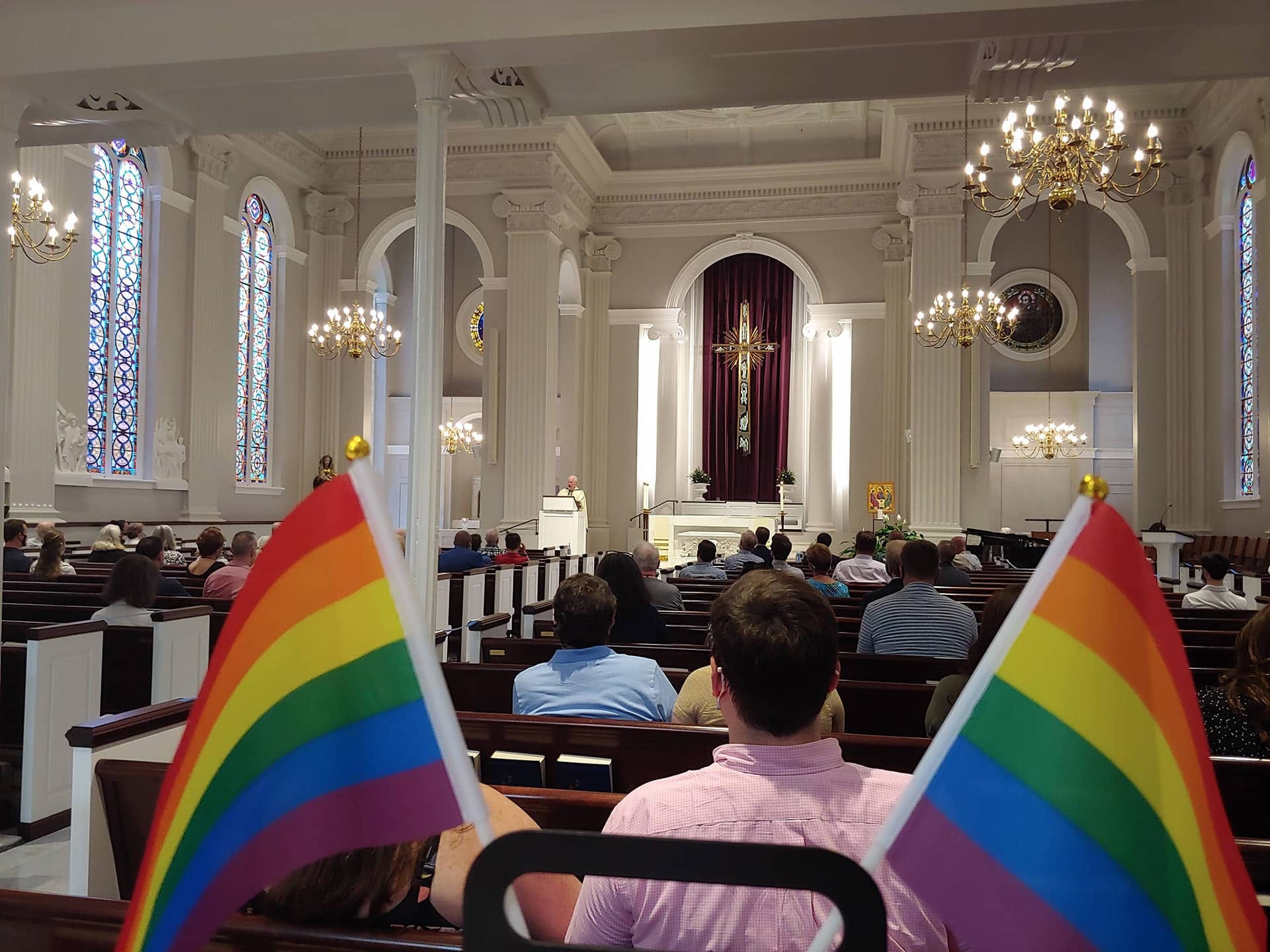
("Holy Trinity “Catholic” Church in DC. Site of Women Lay Preaching Once a Month)
Documentary note: I have examined a photograph of a Jesuit letter, not the physical original. The names, offices, and parish information appearing on it correspond with public records. The letter itself confirms permission for monthly “lay commentary.” The additional claim that the practice involved a woman delivering what functioned as the homily rests on a reader’s firsthand account.
The sentence is buried midway through a letter dated February 4, 2026:
“You should know that the Cardinal has given permission for lay commentary once a month at Holy Trinity.”
The letter appears on Jesuit provincial letterhead. It is signed by Father James Casciotti, S.J., who is publicly listed as the USA East Province’s assistant for pastoral ministries. Copies were sent to Provincial Joseph O’Keefe, S.J., and Father Kevin Gillespie, S.J., the pastor of Holy Trinity Catholic Church in Georgetown. Those names and offices match the Jesuits’ and parish’s current public directories. (Trinity Church)
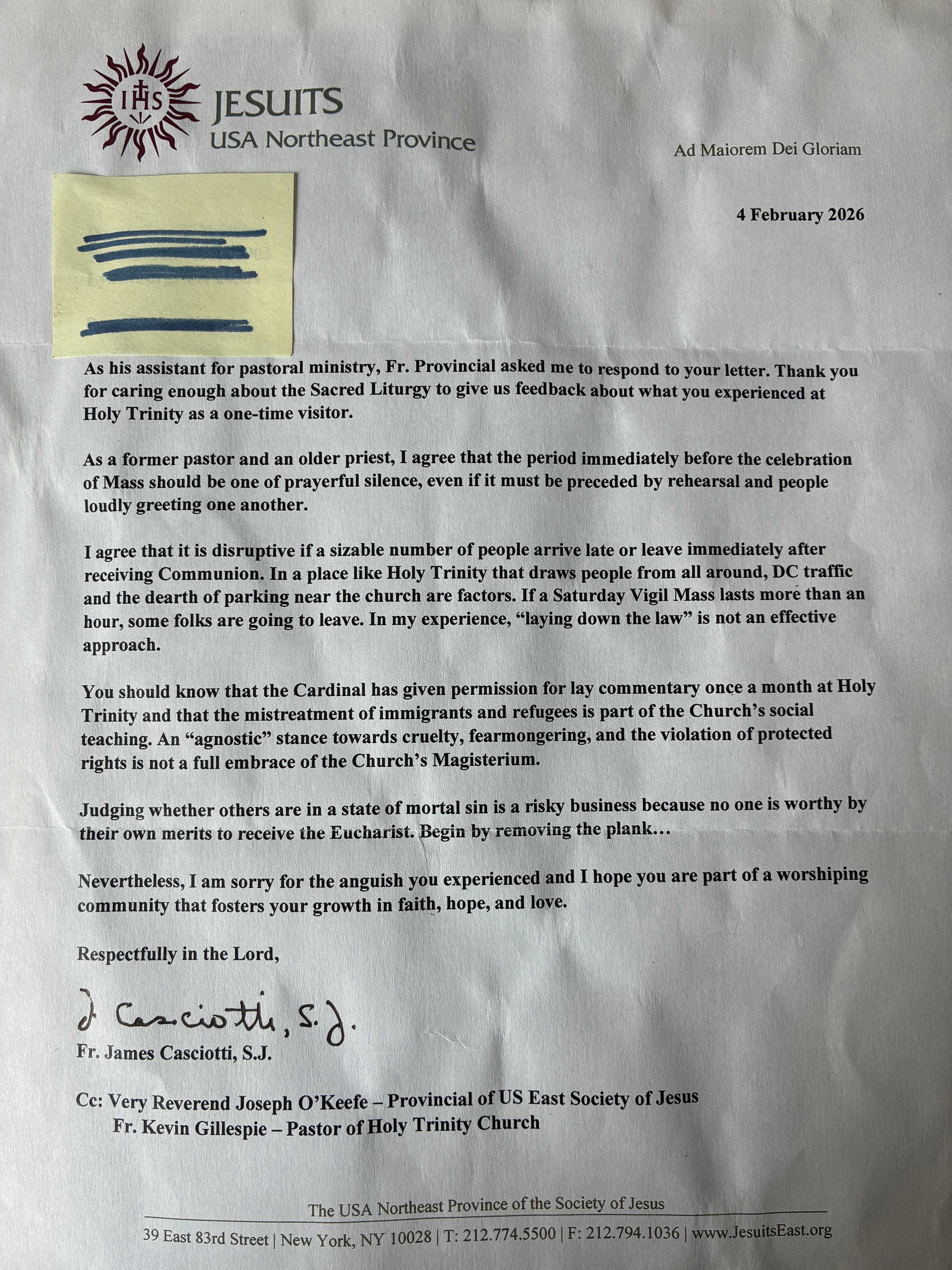
At the time of the letter, the cardinal governing Washington was Robert McElroy. Thus, although the letter refers only to “the Cardinal,” the natural inference is that it means Cardinal McElroy. He was appointed archbishop of Washington in January 2025. (AP News)
A reader says the euphemism concealed the reality he witnessed: a woman delivering what functioned as the sermon, with the priest announcing that Cardinal McElroy wanted the practice to continue.
The photographed letter does not independently establish every detail of that account. It does something narrower, and in some respects more significant. It places in writing an assertion that the cardinal authorized a recurring lay intervention at Mass at one of the most prominent Jesuit parishes in the nation’s capital.
The wording is carefully chosen.
It does not say “homily.”
It says “commentary.”
That single word contains the operating method of the postconciliar revolution.
A Cardinal Cannot Rename a Homily
Current conciliar church canon law permits laypeople to preach under certain limited circumstances in a church or oratory. It immediately adds, however, that this permission remains “without prejudice” to Canon 767, which reserves the homily at Mass to a priest or deacon. (Vatican)
The General Instruction of the Roman Missal is equally direct: the homily may be given by the celebrant, another priest, or sometimes a deacon, “but never by a lay person.” (Vatican)
Redemptionis Sacramentum goes further. It states that the practice of admitting laypeople to preach the homily is “reprobated” and cannot become lawful through custom. The prohibition applies even to seminarians, theologians, pastoral assistants, communities, and associations. (Vatican)
A 1997 interdicasterial instruction explains the reason. It arises from the sacramental connection between Holy Orders, teaching, and sanctifying. According to that instruction, even a diocesan bishop cannot dispense from the rule because it is not merely disciplinary. (Vatican Press)
Cardinal McElroy could permit a layperson to speak before Mass, after Mass, at a parish conference, or in another clearly distinguishable setting allowed by law.
He cannot authorize a lay homily by relabeling it “commentary.”
The legal question therefore concerns substance rather than vocabulary. Where did the commentary occur? Did it follow the Gospel? Did it replace or divide the homily? Was the lay speaker presented to the congregation as interpreting the readings during the Liturgy of the Word? Did the priest give a token introduction before yielding the preaching function?
A diocesan chancery can print almost any noun it likes. A “reflection,” “witness,” “conversation,” “dialogue,” or “commentary” remains a homiletic intervention when it occupies the homily’s liturgical place and performs the homily’s function.
This is why the ambiguity is useful.
A direct order saying, “A woman shall preach the homily once a month,” would be plainly indefensible under the regime’s own law. Permission for “lay commentary” creates an administrative fog in which the practice can proceed while everyone retains deniability.
The euphemism does not resolve the violation.
It facilitates it.
Holy Trinity: Yesterday’s Investigation Becomes Today’s Permission
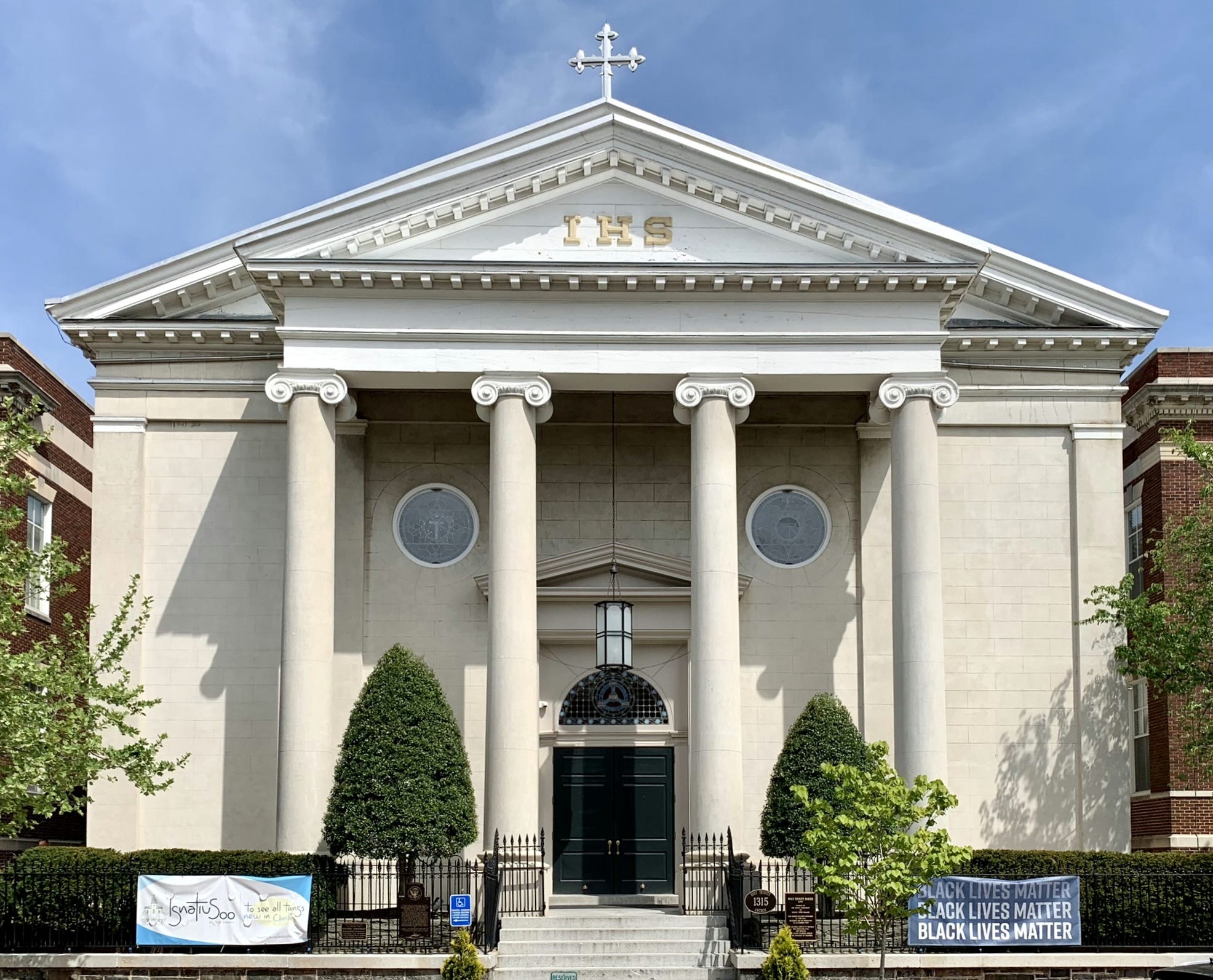
Holy Trinity is no stranger to this controversy.
In 1997, The Washington Post reported that Cardinal James Hickey had ordered an investigation into practices at the Georgetown parish. His concerns reportedly included lay preaching during liturgical services, altered language in readings, and criticism of the Church’s refusal to ordain women. (The Washington Post)
Nearly thirty years later, the photograph supplied by a Hiraeth reader appears to show the provincial assistant for Jesuit pastoral ministries assuring a complainant that “the Cardinal” has granted recurring permission for lay commentary at the same parish.
The contrast measures an institutional transformation.
What once triggered an episcopal investigation now receives an episcopal permission.
Holy Trinity’s present culture also provides context. Its own website hosts “The Women Who Stay,” a feminist Scripture series described as arising from women’s experiences of “exclusion and marginalization in the Catholic Church” and seeking empowerment for the Church’s future. (Trinity Church)
None of that proves what happened at a particular Mass. It does show that the alleged practice would hardly be an alien intrusion into the parish’s institutional environment.
The transformation has occurred through a familiar sequence:
First comes an unauthorized experiment.
Then a complaint.
Then a pastoral explanation.
Then a euphemism.
Then permission for an exceptional case.
Then a recurring schedule.
Finally, the practice becomes so established that questioning it is treated as the real pastoral problem.
Father Casciotti’s reply illustrates the reversal. The complainant raised concerns about conduct surrounding the sacred liturgy. The letter’s sharpest language was directed elsewhere: toward an allegedly inadequate embrace of Catholic social teaching on immigration and toward the danger of judging the spiritual condition of those receiving Communion.
The liturgical complaint received an explanation.
The political disagreement received a rebuke.
The plank was returned to the complainant.
Munich Shows What the Euphemism Is Designed to Accomplish
The German Church has already advanced beyond Washington’s “lay commentary.”
On June 17, 2026, the Vatican’s Dicastery for Divine Worship rejected a formal request from the German bishops to allow qualified laypeople, even under exceptional circumstances, to preach in place of the homily during Mass.
The answer was unusually clear. The reservation of the homily to a priest or deacon, the dicastery said, “is not a merely disciplinary norm but derives from the very nature of the liturgy.” It belongs to the teaching mission sacramentally received through Holy Orders. (Vatican News)
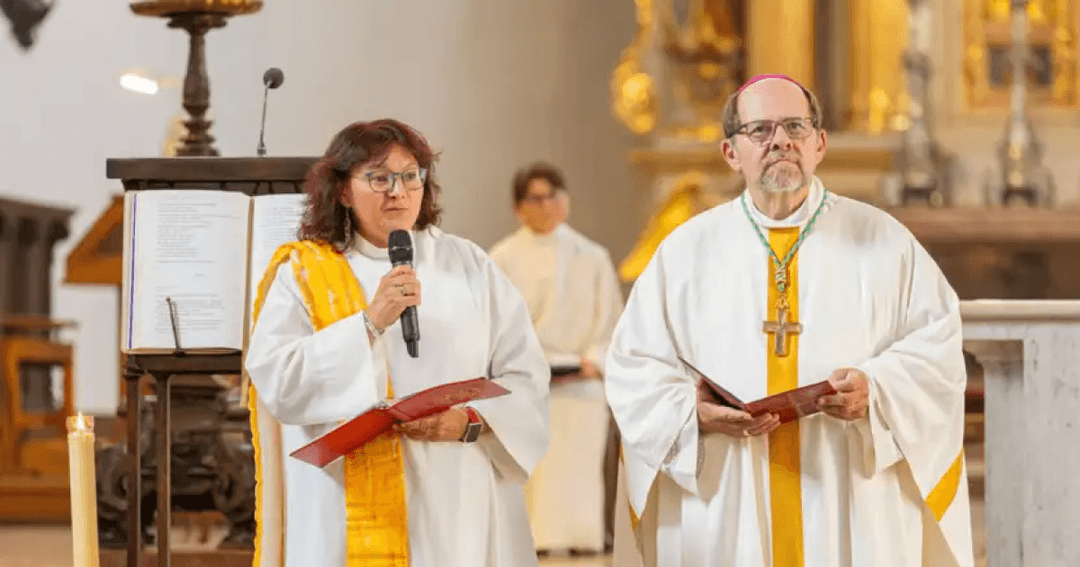
On July 22, barely five weeks later, Auxiliary Bishop Wolfgang Bischof and lay pastoral official Theresia Reischl delivered a “dialogue sermon” together during Mass at St. Michael’s Church in Munich. The archdiocese had publicly advertised that Reischl would deliver a Dialogpredigt with the bishop. (Erzbistum München)
Again, the noun performed the laundering.
Rome prohibited a lay homily.
Munich supplied a dialogue sermon.
One voice would have violated the rule. Two voices supposedly created a new category.
The maneuver is almost childish in its transparency. Its institutional sophistication lies in the fact that everyone involved understands that Rome is unlikely to punish it.
From Same-Sex Blessings to the Bishop’s Pulpit
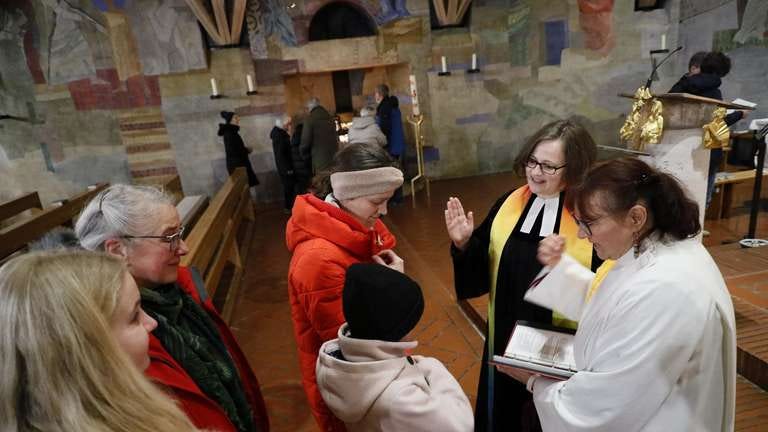
Reischl did not arrive at the episcopal dialogue sermon as an unknown parish volunteer.
In February, she helped organize an ecumenical Valentine’s service at St. Lantpert Church in Freising. The event included blessing stations administered by Catholic and Protestant personnel. A local report identified Reischl beside Protestant pastor Manuela Urbansky at the blessing area and reported that same-sex couples were among those blessed. Deacon Thomas Kirchmeier explained the governing principle: “None of us have a problem with that; they are people in love.” (Merkur)
The report does not identify every couple personally blessed by every individual minister. However, it establishes that Reischl was an organizer and blessing minister at a service that deliberately included same-sex couples, with a Protestant female pastor working alongside the Catholic team.
Two months later, Cardinal Reinhard Marx formally directed pastoral workers in Munich and Freising to use the German guidelines authorizing blessing ceremonies for same-sex and other couples unable to contract sacramental marriage. Clergy unwilling to conduct them were expected to refer couples elsewhere. (National Catholic Register)
Three months after that, Reischl stood beside a Catholic bishop and participated in the sermon at Mass.
These are not disconnected episodes. They reveal the emerging career path of synodal para-clergy. The pastoral professional organizes blessings previously considered impossible. She coordinates ecumenical ritual, leads diocesan commissions, speaks about women’s exclusion and enters the liturgical preaching office beside a bishop.
Her status remains technically lay. Her public ecclesiastical function becomes progressively indistinguishable from that of the ordained minister, except at the precise points where sacramental validity requires the priest’s presence.
The office arrives sociologically before it arrives canonically.
By the time the formal debate over female ordination returns, much of the practical revolution will already have been accomplished. The congregation will have spent years watching women preach, bless, lead, vest, stand in sanctuaries, direct pastoral programs, and exercise authority over priests.
At that point, the male priesthood will appear to many people as the one irrational exception remaining inside an otherwise gender-neutral ministerial system.
That is how symbols prepare doctrine for reversal.
Synodality Is the Constitution That Makes the Exceptions Permanent
The Vatican’s new document, Recollecting: Accompanying the Preparation of the Local Church’s Evaluation Assembly, supplies the administrative architecture.
Published July 27, the document instructs dioceses and eparchies to hold evaluation assemblies during the first half of 2027. Each local Church will produce a narrative report and a “Letter to the Other Churches,” approved by the bishop and submitted by June 30, 2027. National and regional assemblies will follow later in 2027, continental assemblies in 2028, and a Vatican ecclesial assembly in October 2028. (Synod)
The process is described as implementation, not investigation.
The question is no longer whether the Church should become synodal. The dioceses are being instructed to evaluate how synodality has been implemented and what further institutional transformation it requires.
The associated implementation framework proposes inviting representatives of other Christian communities and even other religions as observers. It also asks local Churches to assess lay access to leadership positions that do not require Holy Orders and other ecclesiastical responsibilities. (Synod)
Pope Leo XIV is quoted describing synodality as a “spiritual style” born of encounter, growing through listening, and maturing through discernment. The document expressing that spiritual style consists largely of teams, assemblies, reports, deadlines, templates, stages, evaluations, letters, and submission channels. (Vatican News)
That is not an accidental contradiction. Synodality presents itself spiritually because its institutional ambition is constitutional. A doctrine can be rejected. A decree can be repealed.
A synodal process changes who is present when the question is asked, whose testimony is considered authoritative, what vocabulary governs the discussion, what counts as consensus, and which possible conclusions may emerge without being dismissed as unpastoral.
It redesigns the room before anyone votes.
Why Invite Other Religions to Evaluate a Catholic Diocese?
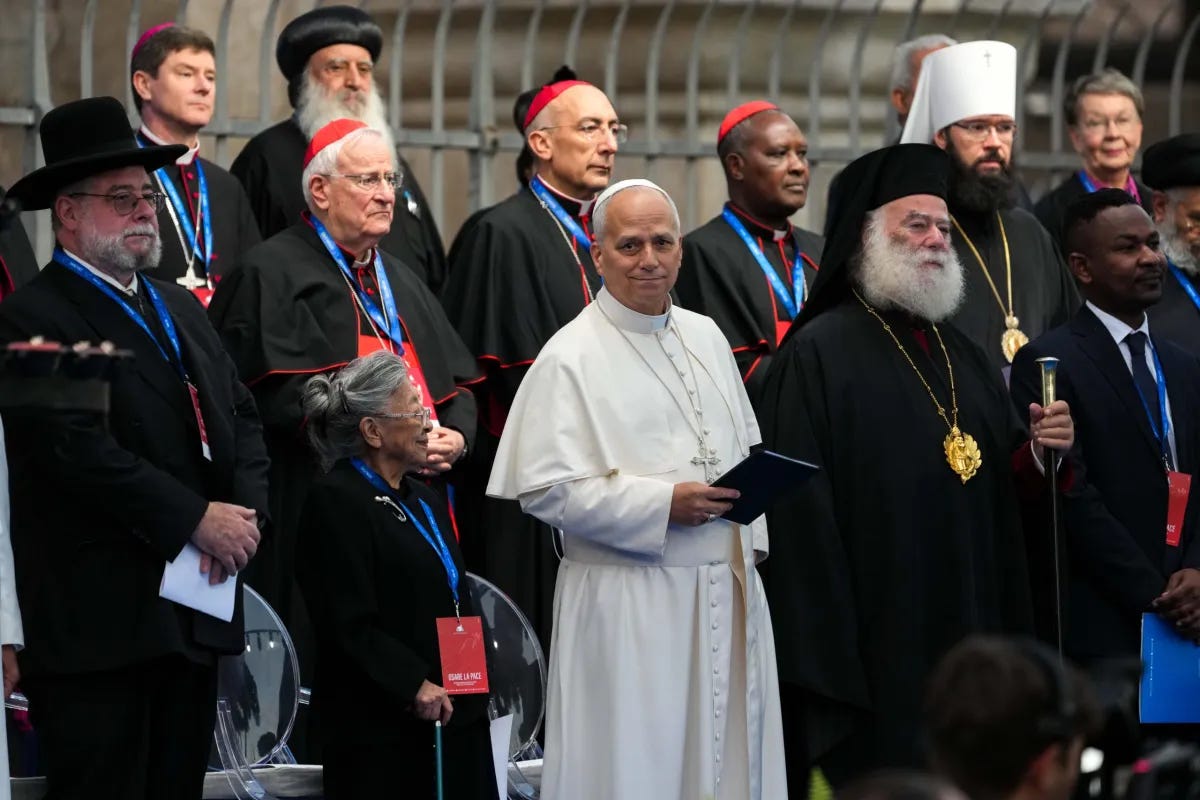
Inviting a Protestant or non-Christian observer to a Catholic meeting is not inherently apostasy. The Church has long received guests, consulted outside experts, and worked with non-Catholics on matters of common concern.
The purpose and setting matter.
These observers are being considered within a process by which the local Church evaluates its own synodal identity, relationships, decision-making structures, leadership patterns, and future reforms.
The danger lies in the operative standard.
A Catholic diocese exists to profess the revealed faith, offer the true sacrifice, administer the sacraments, govern the baptized, and convert souls to Jesus Christ.
A Muslim, Hindu, Jewish, or secular observer does not share that ecclesial end. His approval may be useful as a measure of friendliness, coexistence, social service, or civic dialogue. It cannot measure fidelity to the Catholic mission.
Once his observations enter the discernment process, however, the diocese is encouraged to see itself partly through the eyes of those who reject its supernatural claims.
Catholic distinctiveness then becomes a relational difficulty to be managed. A forceful proclamation of Christ as the only Savior may be judged insufficiently dialogical. A male priesthood may appear exclusionary. Missionary conversion may appear triumphalist. Moral condemnation may appear unwelcoming.
The other religion is introduced as an observer. Its presence silently supplies a criterion.
The process does not need to deny the faith explicitly. It teaches Catholics to evaluate their faith according to the comfort of those who do not possess it.
The Mother-Daughter Ministry and the Reversal of Fifteen Centuries
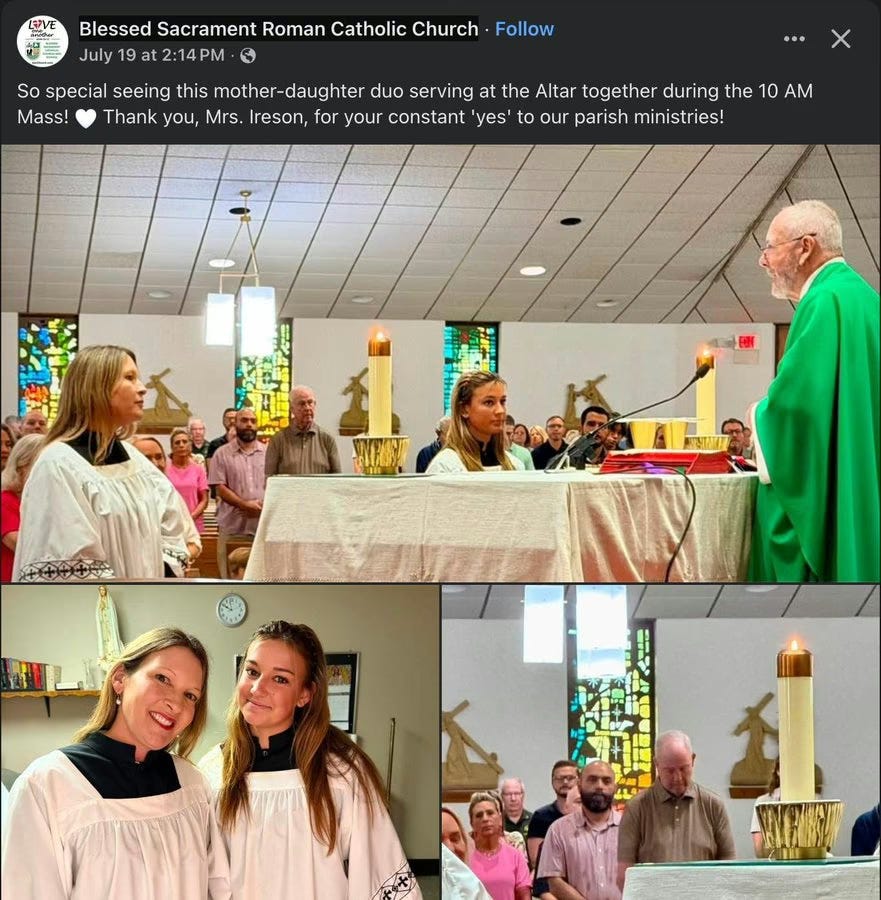
The photograph from Blessed Sacrament parish in Fort Lauderdale shows a mother and daughter vested as servers beside the altar. The parish celebrates how “special” it was to see them serving together and thanks the mother for her continuing “yes” to parish ministries.
Under present conciliar discipline, this is somehow lawful. American bishops may permit women and girls to serve at the altar, while Francis’s 2021 Spiritus Domini opened the formally instituted ministry of acolyte to women.
The postconciliar system did not merely tolerate an old abuse. It reversed a teaching defended explicitly by three popes.
Pope Gelasius I rebuked bishops in 494 because:
“So great a contempt for divine things has crept in, that women are said to minister at the sacred altars.”
He placed particular blame upon the priests who permitted such conduct.
When the practice appeared among Eastern Christians, Pope Innocent IV ordered:
“Women must not dare to serve at the altar, but must be entirely excluded from this ministry.”
That prohibition was later preserved and cited by Benedict XIV.
Finally, in Allatae Sunt, Pope Benedict XIV described it as:
“The evil practice … of women serving the priest at the celebration of Mass. … We too have forbidden this practice in the same words.”
The historical sequence is therefore unmistakable:
Gelasius called it contempt for divine things. Innocent IV ordered women excluded from the ministry. Benedict XIV called it an evil practice and prohibited it again. Francis formally instituted women as acolytes.
Something repeatedly condemned because it violated the male character of service at the altar is now presented as a natural consequence of baptismal equality.
Historically, the sanctuary formed a visible school of priestly vocation. Not every altar boy became a priest, but the service was ordered symbolically toward the male priesthood. Boys learned the gestures, discipline, hierarchy and sacred proximity of the Holy Sacrifice.
The modern system gives the role another meaning: inclusion, participation, representation and parish involvement.
The caption gives the game away. Its emphasis is not upon assisting the priest at the offering of sacrifice. It is upon the mother-daughter duo. Their family relationship becomes the meaning of the sanctuary scene. Sacred service is repackaged as a heartwarming ministry opportunity.
The women themselves are doing what their parish celebrates and conciliar law permits. The indictment belongs higher up; with the ecclesiology that transformed a male service ordered toward priesthood into another platform for equal representation.
The photograph catechizes without argument. It teaches that sanctuary functions are parish opportunities available to everyone. Once that symbolic world has been established, reserving priestly ordination to men inevitably begins to appear arbitrary.
The doctrine of the male priesthood may still be recited. The liturgical environment has been trained to contradict its logic.
That is what the photograph records: something condemned by three popes—one of them explicitly calling it an evil practice—now presented as an adorable family moment.
Bishop Defends Nude LGBT Demonstration Outside Cathedral
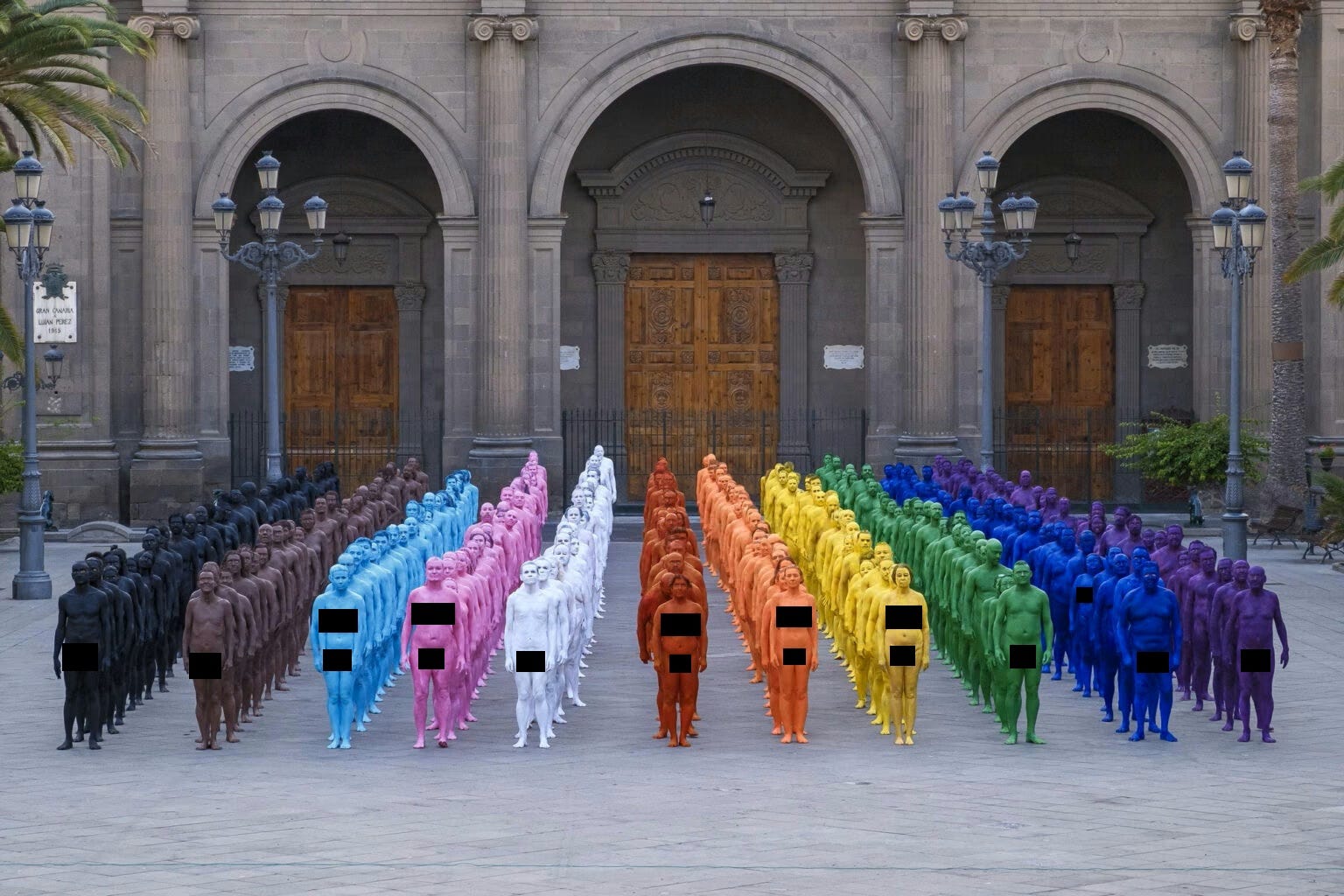
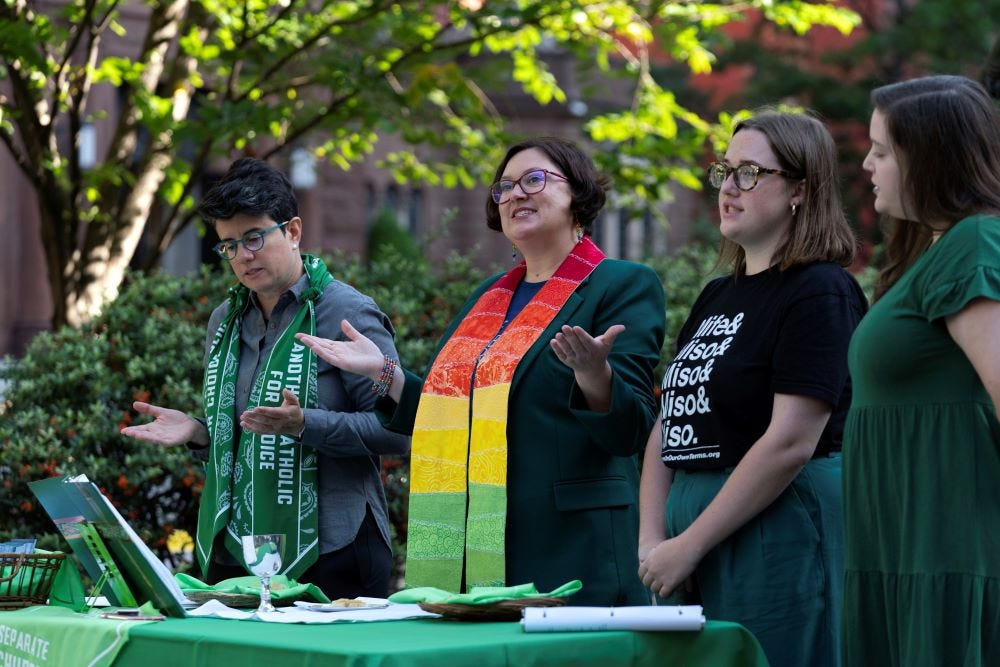
(This is a redacted photo. Everyone pictured was fully nude outside the Cathedral)
The event in Las Palmas de Gran Canaria carried the same logic into public space.
On July 26, between 400 and 500 nude participants, painted in the colors of the Progress Pride flag, assembled before the Cathedral of Santa Ana for Spencer Tunick’s Gran Spectrum. The installation formed part of the Culture & Business Pride festival and was explicitly promoted as a celebration of LGBTQ identity, inclusion, and rights.
The timing and setting intensified the desecration. It took place on the feast of St. Anne, the city’s patroness, while Catholics were attempting to reach the cathedral for Mass.
Bishop José Mazuelos’s principal objection concerned traffic and access. He complained that the street closures delayed clergy and worshippers. He apparently had no comparable objection to using the façade of his cathedral as the backdrop for hundreds of naked, rainbow-painted bodies.
“I have no problem,” he told El País. “When we go to the beach, we see naked bodies, don’t we?”
No, Bishop, most people do not go to the beach and encounter five hundred fully nude adults arranged into a Pride flag.
Perhaps the bishop visits very different beaches from the rest of us. In any event, his comparison was morally incoherent. The sight of swimmers in ordinary beach attire bears no resemblance to a premeditated mass-nudity spectacle staged for political and sexual symbolism outside a Catholic cathedral.
This was no accidental gathering of bathers near a church. The organizers deliberately selected the cathedral. Its towers supplied historical weight. Its façade supplied Christian symbolism. Its sacred character supplied the transgressive force without which the photograph would have been another group of naked people standing in another public square.
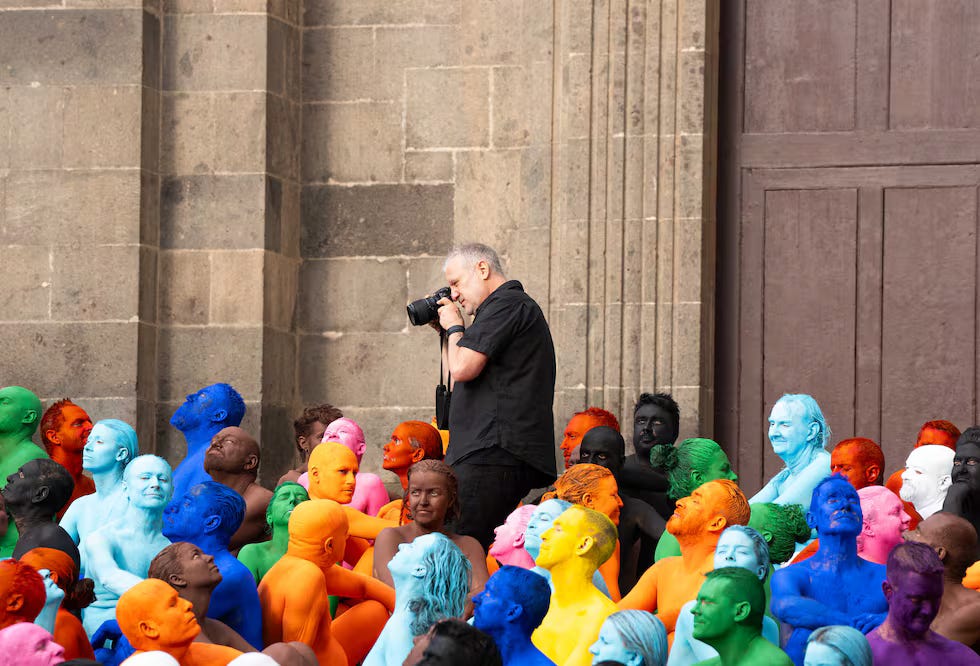
The bishop was also reported as calling the event useful “marketing for the city” and saying that whatever promoted the city was good.
That response was more revealing than outrage would have been.
He treated the cathedral as municipal scenery: an attractive monument available for tourism, civic branding, and ideological theater. His concern began only when the production interfered with the schedule inside.
He objected when naked activists obstructed access to the Eucharist.
He did not object when they conscripted the house of God into their message.
Mass may still be celebrated behind the doors. Outside them, the city—and apparently the bishop—has accepted that the cathedral’s meaning belongs to whoever produces the most marketable spectacle.
The FSSP Bulletin and the Price of Canonical Shelter
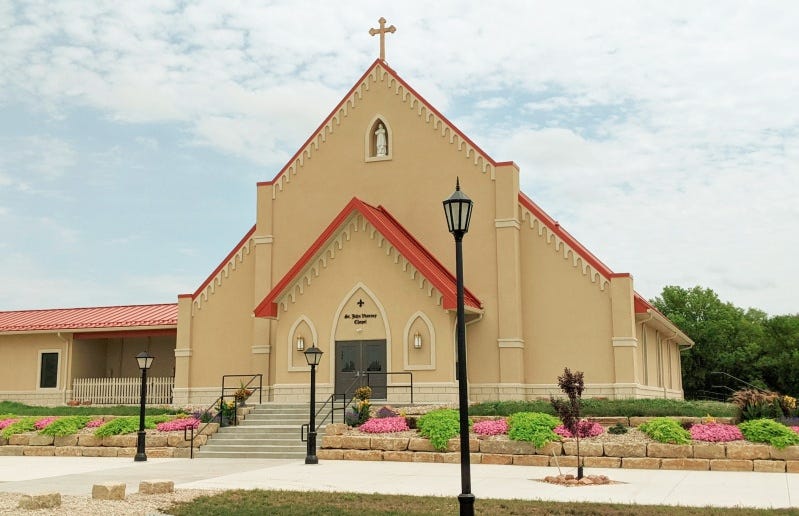
The next story presents a brutally different exercise of ecclesiastical authority.
A bulletin from St. John Vianney Chapel, the FSSP apostolate in Maple Hill, Kansas, lists “practical considerations” concerning the SSPX and says the same restrictions apply to the CMRI and the SSPX Resistance.
The faithful are told:
Do not enroll children in the SSPX academy.
SSPX members may not serve as baptismal or confirmation sponsors at St. John Vianney.
St. John Vianney members may not serve as sponsors at the Immaculata.
Do not attend SSPX marriages.
Do not receive confession from SSPX priests.
Attend SSPX funerals only for a sufficient reason, passively and without receiving Communion.
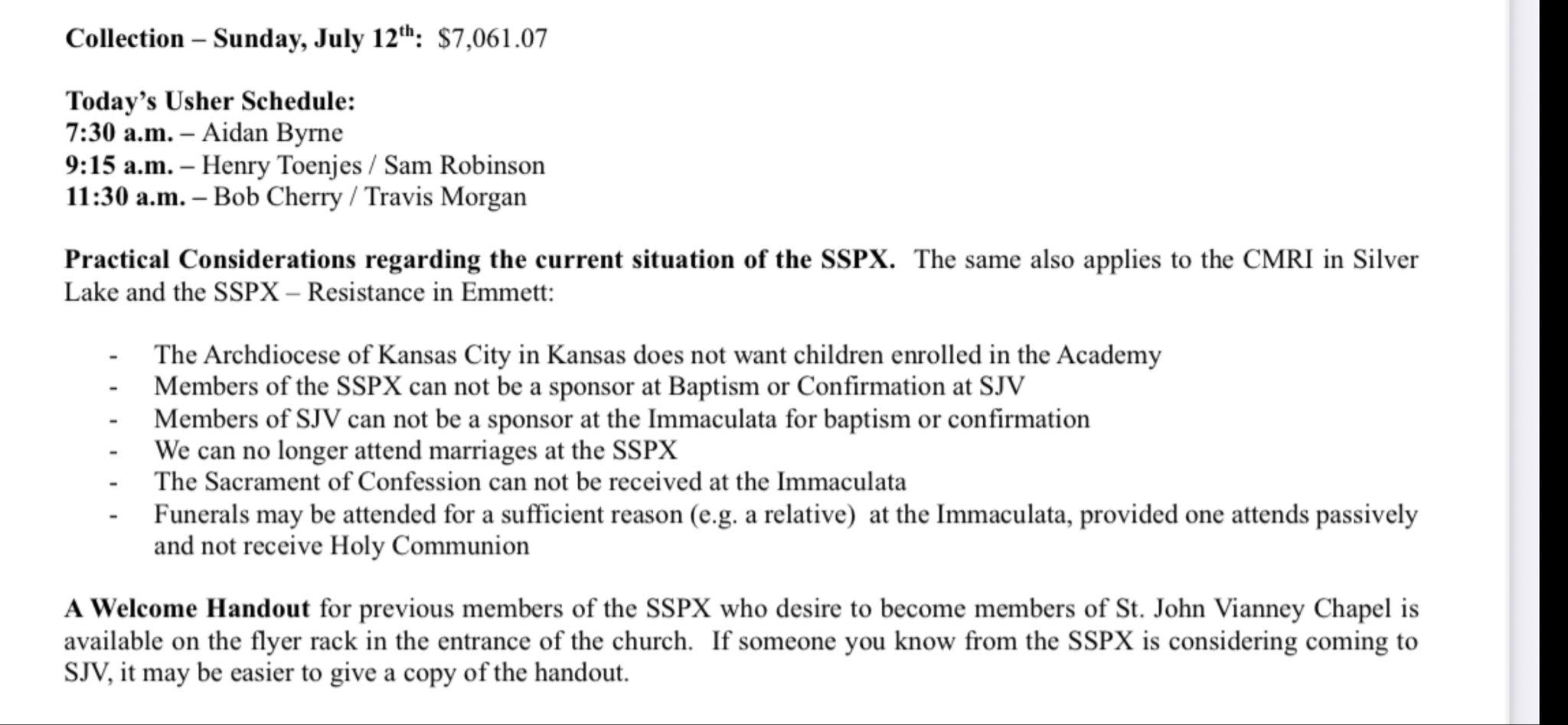
The bulletin then advertises a “Welcome Handout” for former SSPX members seeking to join the FSSP chapel.
That handout has now surfaced.
Its title is revealing:
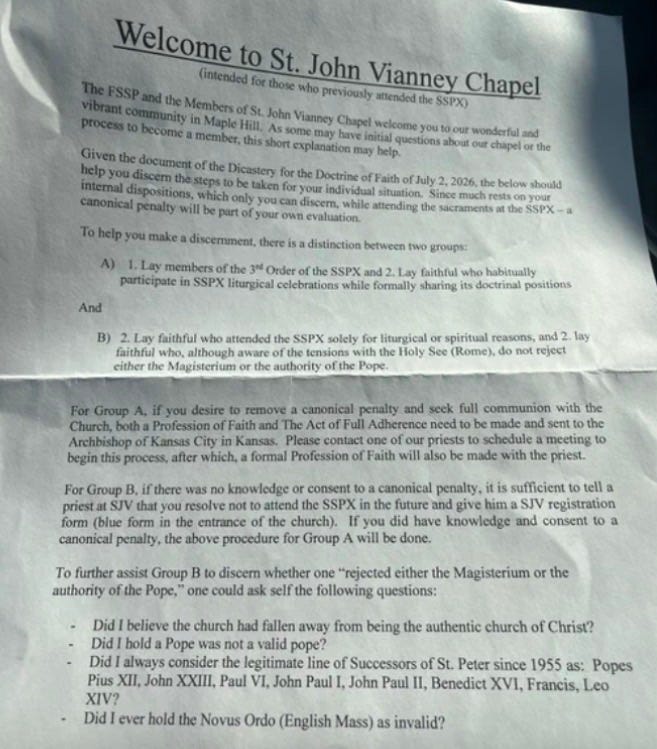
“Welcome to St. John Vianney Chapel—intended for those who previously attended the SSPX.”
The document invokes the Dicastery for the Doctrine of the Faith’s July 2 decree and divides former SSPX faithful into two groups.
The first includes members of the SSPX Third Order and people who habitually attended SSPX liturgies while “formally sharing its doctrinal positions.” They are told that, to remove the presumed canonical penalty and seek “full communion,” they must submit a Profession of Faith and an “Act of Full Adherence” to the Archbishop of Kansas City in Kansas, followed by another formal profession before an FSSP priest.
The second group includes those who attended solely for liturgical or spiritual reasons and those who knew of the SSPX’s conflict with Rome but did not reject the Magisterium or papal authority. Even they must tell the FSSP priest that they resolve never to attend the SSPX again and submit a parish registration form.
This distinction loosely follows the Vatican’s explanatory note, which treats formal adherence, not mere attendance, as the condition under which laypeople become schismatic and excommunicated. Yet the same Vatican document warns everyone to abstain from SSPX worship and declares SSPX confessions and marriages invalid. The Maple Hill packet is therefore no freelance excess by an unusually hostile priest. It is a local intake procedure implementing Rome’s new policy.
A Loyalty Examination at the Chapel Door
The most revealing part comes at the bottom of the handout. Former SSPX attendees are instructed to examine themselves with four questions:
“Did I believe the Church had fallen away from being the authentic Church of Christ?”
“Did I hold a Pope was not a valid pope?”
“Did I always consider the legitimate line of Successors of St. Peter since 1955 as: Popes Pius XII, John XXIII, Paul VI, John Paul I, John Paul II, Benedict XVI, Francis, Leo XIV?”
“Did I ever hold the Novus Ordo (English Mass) as invalid?”
This is more than a sacramental questionnaire. It is an ideological border inspection.
The prospective member is not merely asked whether he believes the Creed, accepts the sacraments, or intends to live as a Catholic. He must audit his thoughts about the entire postconciliar settlement.
Did he ever conclude that the visible institution had ceased to function as the authentic Church?
Did he ever doubt any claimant to the papacy?
Did he accept an uninterrupted succession from Pius XII through Leo XIV?
Did he ever question the validity of the Novus Ordo?
The unexplained date of 1955 is particularly strange. Pius XII became pope in 1939. The handout nevertheless begins its required “legitimate line” in the year associated with the first major Holy Week reforms, although the document offers no explanation for its choice.
Its phrase “Novus Ordo (English Mass)” is also revealingly imprecise. The Novus Ordo may be celebrated in Latin, while vernacular worship existed before Paul VI’s missal. The phrase reduces the whole liturgical revolution to a language preference, as though traditionalists objected principally to English rather than to a reconstructed rite, a changed theology of worship, and the destruction of the Roman liturgical inheritance.
More significantly, the questionnaire tests former SSPX faithful for positions that the SSPX itself officially rejects. The Society publicly condemns sedevacantism, recognizes the postconciliar claimants as popes, and names the recognized pontiff in the Canon. It criticizes the Novus Ordo as dangerous to the Faith but does not officially teach that every celebration of it is intrinsically invalid.
The packet therefore casts a wider net than necessary merely to distinguish SSPX doctrine from sedevacantism. Anyone who came to conclusions more radical than the official SSPX position must disclose those thoughts as evidence of possible schism.
The internal crisis of conscience that drove the person away from diocesan Catholicism becomes evidence against him.
The scandals he witnessed are irrelevant.
The contradictions he studied are irrelevant.
The doctrinal ruptures that disturbed him are irrelevant.
The question is whether he eventually drew a forbidden conclusion.
The Licensed Traditionalist Has Less Freedom Than the Revolutionary
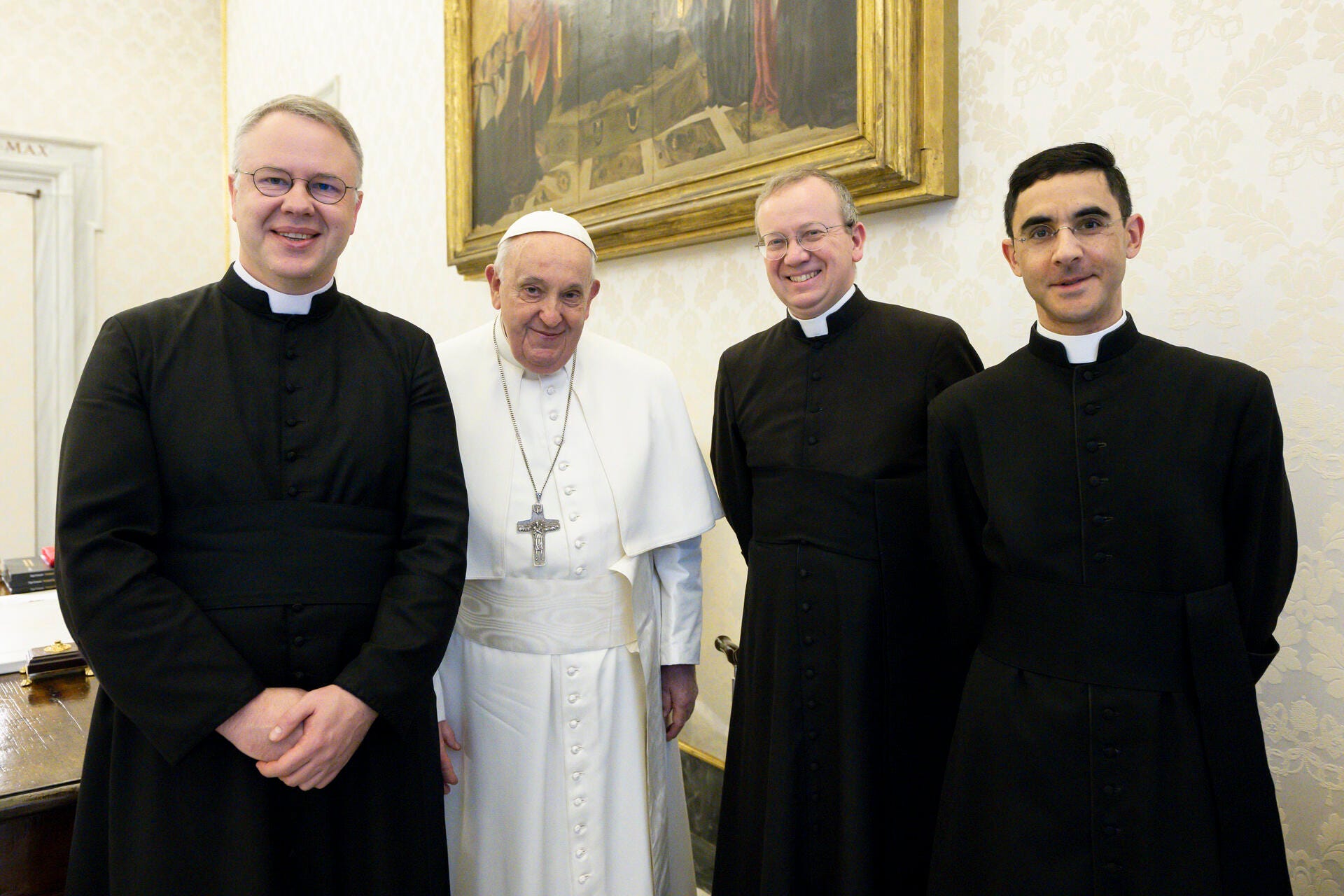
(The FSSP’s audience with Francis on February 29, 2024)
This is where all the stories converge.
At Holy Trinity, a cardinal reportedly authorizes monthly “lay commentary,” although the Church’s own law reserves the homily to the ordained.
In Munich, a bishop shares his sermon with a laywoman after Rome has explicitly refused permission for lay preaching.
The same pastoral establishment organizes blessings for same-sex couples and presents those ceremonies as ordinary accompaniment.
The Vatican builds a permanent synodal apparatus that evaluates new leadership roles for the laity and considers inviting other religions into the process.
A Florida parish celebrates the sanctuary as a location for mother-daughter ministry.
A Spanish bishop accepts the use of his cathedral as a Pride-festival backdrop because naked bodies can also be seen at the beach and the production provides municipal marketing.
Then the FSSP bulletin appears.
Suddenly the language loses its ambiguity.
No commentary.
No dialogue.
No process.
No accompaniment.
No discernment.
The answer is prohibition.
Do not attend.
Do not confess.
Do not sponsor.
Do not enroll.
Do not receive Communion.
The modern hierarchy is fully capable of drawing boundaries. It draws them most forcefully around those who reject its authority or expose the contradictions of its settlement.
Progressive Disobedience Confirms the System
The apparent double standard becomes coherent once one understands the direction of travel.
Progressive disobedience advances the regime’s underlying ecclesiology.
It diminishes distinctions between clergy and laity, expands the public authority of women, transforms moral judgment into accompaniment, treats liturgy as communal expression, opens governance to permanent consultation, elevates religious dialogue above conversion and converts sacred property into civic space.
A progressive may violate a current rule, but he generally does so in the name of the system’s own deepest principles: participation, inclusion, synodality, co-responsibility, dialogue, and pastoral adaptation.
He is disobedient tactically and loyal strategically.
The traditionalist often does the reverse.
He may observe older rubrics, preach older doctrine, maintain older moral discipline, and preserve older forms of Catholic life. Yet if he concludes that Vatican II, the new liturgy, or the postconciliar hierarchy represents a rupture, his obedience threatens the system strategically.
He obeys what the Church taught before the revolution and therefore becomes disobedient to the revolution’s managers.
The regime tolerates the person who breaks its rules while advancing its trajectory.
It fears the person who keeps the older rules while denying the trajectory.
The Traditionalist Reading
None of these incidents, considered alone, proves that the Holy See is vacant.
A bad bishop can tolerate obscenity.
A cardinal can exceed his authority.
A priest can manipulate liturgical terminology.
A German auxiliary can disobey Rome.
A parish can sentimentalize ministry.
An FSSP bulletin can express an overly severe local interpretation.
Catholic history contains corruption, cowardice, careerism, and confused administration. The cumulative problem is deeper. The same direction appears repeatedly across countries, institutions, legal documents, pastoral programs, liturgies, and episcopal responses.
The sanctuary becomes less sacerdotal.
The homily becomes less ordained.
Blessings become less connected to moral truth.
Governance becomes less hierarchical in operation while remaining hierarchical in enforcement.
The cathedral becomes less sacred.
Mission becomes dialogue.
Conversion becomes accompaniment.
Tradition becomes a licensed enclave whose occupants must continually affirm the legitimacy of the forces that devastated it.
An observer does not see a random collection of abuses. He sees a rival rule of faith operating through Catholic offices.
The central question is no longer whether every individual officeholder privately believes every Catholic doctrine.
The question is what the visible institution consistently treats as good, permissible, dangerous, and intolerable.
That hierarchy of values reveals the religion being administered.
Read the Permissions
The most revealing word in these stories is not “homily,” “synod,” “blessing,” or “tradition.”
It is “permission.”
Permission for lay commentary.
Permission for blessing ceremonies.
Permission for female altar ministry.
Permission for non-Catholic observers.
Permission to use the old liturgical books.
Permission for a rainbow spectacle outside the cathedral.
Every permission describes the authority granting it and the order it intends to build.
Holy Trinity’s lay voice receives permission.
Munich’s dialogue sermon receives a euphemism.
Freising’s same-sex couples receive blessings.
The Synod’s outside observers receive seats.
The Pride festival receives the cathedral façade.
The FSSP receives the old Mass under conditions.
The SSPX family receives a warning to stay away.
The postconciliar Church has boundaries after all.
They are simply drawn around the revolution.
If you value independent Catholic analysis and want to help keep this work going, you can make a contribution or subscribe below. Every donation and subscription directly supports the writing, research, and production of Hiraeth in Exile.
Thank you for helping preserve independent Catholic journalism rooted in truth and tradition.
Where does Canon law or any other rule of the Church hold or imply that it is a violation of Catholic principles for a Catholic to believe that a certain claimant to the papal chair is not valid?
During the Great Western Schism, when there were two and even three competing claimants to the papal chair, virtually every Catholic necessarily thought that there was a false claimant to the papal chair.
as always, your research and writing is excellent. what is most interesting is that you end the titles of your most recent articles with: "....meanwhile the sspx is in 'schism'". the reality of your research brings us to full circle.